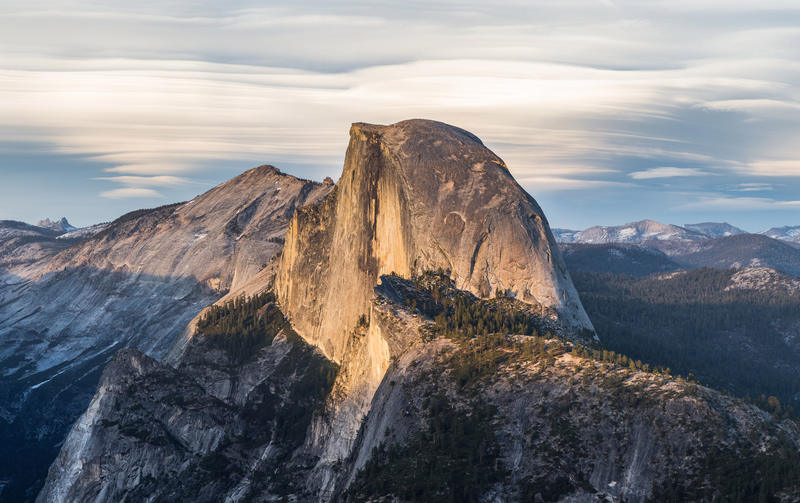
The best sunset spots at Yosemite National Park are Tunnel View and Valley View on Highway 41 (open year-round), plus Glacier Point, Sentinel Dome, and Taft Point on Glacier Point Road (typically open late May into November). For golden light on El Capitan and Half Dome, arrive about 45 minutes before posted sunset.
What are the best sunset spots in Yosemite?
These six viewpoints cover the full range, from drive-up overlooks to short hikes that reward you with a quieter clifftop. Here's the shortlist, ranked by how easy each is to reach:
- Tunnel Viewthe iconic drive-up view; El Capitan, Bridalveil Fall, and Half Dome in one frame. Year-round.
- Valley Viewriverside, low-key, El Capitan reflected in the Merced. Year-round.
- Cook's Meadowflat valley-floor stroll with Half Dome catching warm light. Year-round.
- Glacier Pointthe big one: about 3,200 feet above the valley, Half Dome at eye level. Seasonal.
- Sentinel Dome360-degree summit, the best all-around panorama. Seasonal.
- Taft Pointexposed clifftop with the famous fissures. Seasonal.
Tunnel View: the easiest sunset in Yosemite
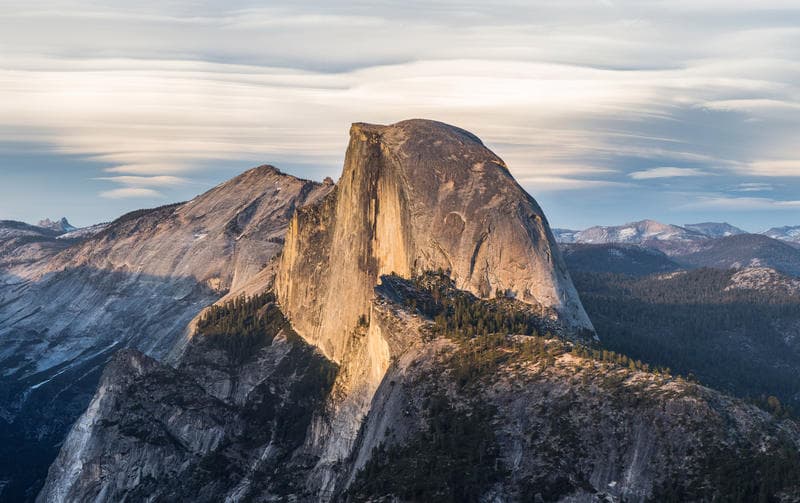
If you only do one, do this. Tunnel View sits on Highway 41 (Wawona Road) just as you exit the long tunnel heading out of the valley, roughly a 10-minute drive (about 4 miles) southwest of Yosemite Village. There's a paved pull-out on each side of the road and no hiking required. At sunset the last light hits El Capitan and Half Dome, and on clear evenings Bridalveil Fall catches a gold sheen.
It's the most popular overlook in the park, so the lot fills 30 to 45 minutes before sunset in summer and on holiday weekends. Arrive early, aim for the upper (south) side, and bring a layer; the canyon funnels cold air fast once the sun drops.
Is Glacier Point Road open? (Seasonal closure explained)
This trips up a lot of visitors. Glacier Point Road is the only road access to Glacier Point, Sentinel Dome, and Taft Point, and it closes with snow every winter. It typically opens around late May and closes again with the first heavy snow, usually sometime in November. Exact dates vary year to year, so check the park's current road conditions before you plan a sunset there. If you're visiting roughly December through April, those three viewpoints are off the table by car, so default to Tunnel View, Valley View, or Cook's Meadow on the valley floor.
From Yosemite Valley, the drive to Glacier Point is about an hour (roughly 30 miles via Highway 41 and Glacier Point Road), so leave the valley at least 90 minutes before sunset to allow for traffic and parking.
Glacier Point: the showstopper overlook
Glacier Point is the most dramatic sunset in the park and it's nearly effortless: a paved, mostly level path of a few hundred yards from the parking area to the railed overlook. You're about 3,200 feet above the valley floor, roughly eye-to-eye with Half Dome and looking down toward Vernal and Nevada Falls. As the sun sets, alpenglow turns Half Dome's face orange and pink. The lot is large but fills on summer weekends, so come early. After dark it's also a strong stargazing spot, so it's worth lingering.
Sentinel Dome and Taft Point: short hikes worth the effort
These two share a trailhead on Glacier Point Road, a couple of miles before Glacier Point itself. Park in the same lot and pick your direction.
Sentinel Dome is roughly 2.2 miles round trip with a few hundred feet of elevation gain, ending on a bald granite summit at about 8,100 feet. It's the only spot here that gives you a true 360-degree panorama, including a clear line to El Capitan, Half Dome, and the high country. It's the pick for photographers who want options in every direction.
Taft Point is also about 2.2 miles round trip and nearly flat, leading to a clifftop with deep granite fissures and a small railed platform. The exposure is real, with long unfenced drop-offs, so keep kids close and don't get cute near the edge for a photo (dogs aren't allowed on this trail). Its west-facing aspect makes it one of the best places to watch the sun actually drop below the horizon.
Important: hike out with a headlamp. Both trails are unlit, and walking back over granite in the dark without a light is how people get hurt.
Valley View and Cook's Meadow: year-round valley-floor options
Valley View (also called the "Gates of the Valley") is a small pullout on Northside Drive along the Merced River, near the west end of the valley loop. When the river is calm, El Capitan and Cathedral Rocks reflect in the water as the light goes warm. It's quieter than Tunnel View.
Cook's Meadow is a flat, easy loop (about a mile on boardwalk and dirt) in the heart of the valley near Yosemite Village. At sunset Half Dome catches the last light above the meadow, and Sentinel Rock glows. It's the best low-effort option if you're staying in the valley and don't want to drive.
What is the Yosemite "firefall"?
For roughly two weeks in mid-to-late February, the setting sun can hit Horsetail Fall on the east face of El Capitan at just the right angle to make the thin waterfall glow orange, like flowing lava. This natural "firefall" only works if three things line up: the fall is flowing (it needs recent snow or rain), the western sky is clear at sunset, and you're there in that narrow February window. The park runs traffic controls and designated viewing areas during peak firefall dates, typically along Northside Drive near the El Capitan Picnic Area, often with a walk in from the Yosemite Falls parking area. Check current rules before going and arrive a couple of hours early to claim a spot.
When should I arrive for sunset at Yosemite?
Look up the day's exact sunset time (it ranges from around 4:45 p.m. in December to past 8:30 p.m. in late June) and plan backward. For drive-up spots like Tunnel View, arrive about 45 minutes early for parking and pre-sunset color. For Glacier Point, leave the valley 90 minutes before sunset. For Sentinel Dome or Taft Point, start hiking at least an hour before sunset so you're settled in for golden hour with light to spare for the walk back.
Entrance to Yosemite is $35 per private vehicle for a 7-day pass (non-U.S. residents pay an added per-person fee as of 2026). Timed entry reservations are not required for 2026, but crowds and traffic are still heaviest in the late afternoon, so build in buffer time at the entrance station.
Practical tips from the trail
- Bring a headlamp for any of the Glacier Point Road hikes; phone flashlights die fast in the cold.
- Pack a warm layer even in summer. The temperature drops sharply at altitude once the sun is gone.
- Gas up before you enter. There's no gas in Yosemite Valley; the nearest stations are at Crane Flat, Wawona, or El Portal.
- Cell service is spotty to nonexistent, so download maps and sunset times in advance.
- For firefall in February, expect heavy crowds, traffic control, and road closures; treat it as a planned outing, not a spontaneous stop.
Sunset at Yosemite National Park: 6 Best Spots & Timing FAQs
Tunnel View on Highway 41 is the best easy-access sunset spot, framing El Capitan, Bridalveil Fall, and Half Dome with no hiking. For the most dramatic light, Glacier Point puts you about 3,200 feet above the valley near eye level with Half Dome, but its road is only open roughly late May into November.
No. Glacier Point Road closes every winter due to snow and typically reopens around late May, closing again with heavy snow in November. From roughly December through April, Glacier Point, Sentinel Dome, and Taft Point are not reachable by car, so use Tunnel View, Valley View, or Cook's Meadow on the valley floor instead.
From Yosemite Valley it's about a 1-hour drive (roughly 30 miles) via Highway 41 and Glacier Point Road. Leave the valley at least 90 minutes before sunset to allow for traffic, parking, and the short walk to the overlook.
The firefall happens for about two weeks in mid-to-late February, when the setting sun lights up Horsetail Fall on El Capitan. It only appears if the fall is flowing and the western sky is clear at sunset. The park uses traffic controls and designated viewing areas during peak dates, so check current rules before you go.
Arrive about 45 minutes before posted sunset for drive-up spots like Tunnel View. For hikes to Sentinel Dome or Taft Point, start walking at least an hour early so you have golden-hour light and time to hike out before dark with a headlamp.
Not for 2026. Timed entry reservations are not required, though every vehicle still needs a valid entrance pass ($35 per vehicle for 7 days). Crowds and traffic are heaviest in the late afternoon, so leave extra buffer at the entrance station so you don't miss sunset.