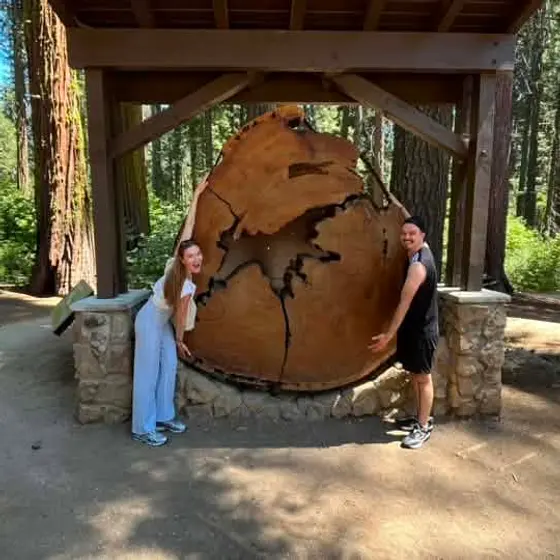
The best things to do in Sequoia National Park are standing under General Sherman (the largest tree on Earth by volume), climbing the stone stairway up Moro Rockwalking the Congress Trail and Crescent Meadowdriving through Tunnel Loghiking to Tokopah Fallsand touring Crystal Cave (reservation only). Most cluster in the Giant Forest.
How much time do you need in Sequoia?
One full day covers the headliners if you start early: General Sherman, Congress Trail, Moro Rock, Crescent Meadow and Tunnel Log all sit within a few miles of each other in the Giant Forest. Two days lets you add Tokopah Falls and a Crystal Cave tour without rushing. I'd plan two if you're driving in from Los Angeles or the Bay Area anyway.
Entrance is $35 per vehicle for a 7-day pass (covers both Sequoia and Kings Canyon), or use the $80 America the Beautiful annual pass. There's no timed entry reservation to get into the park itself in 2026, but Crystal Cave is separate and books out.
See the General Sherman Tree and walk the Congress Trail
This is the one thing you can't skip. The General Sherman Tree is the largest living single-stem tree by volume on the planet. The main trail down to it is about 0.5 mile each way (roughly 1 mile round trip) and paved, dropping around 190 feet on the way in, which means a steady uphill on the way back at 6,800+ feet elevation. Take your time; the altitude is real if you've come from sea level.
From the base of Sherman, the Congress Trail peels off as a paved loop of roughly 2 to 3 miles (sources vary by where you count the spurs) through one of the densest stands of giant sequoias anywhere. It passes the House and Senate groups, named clusters of trees standing shoulder to shoulder. It's quiet, mostly flat, and honestly more impressive than Sherman itself. Budget 1 to 1.5 hours.
In summer (roughly late May through September), you can't drive to the Sherman parking area directly. Park at the Sherman Tree main lot off Wolverton Road and use the free shuttle, or walk in. Arrive before 9 a.m. or after 3 p.m. to dodge the worst of the crowds and the parking scramble.
Climb Moro Rock
Moro Rock is a granite dome with a stone stairway carved into it by the Civilian Conservation Corps in the 1930s. The climb is about 0.25 mile and gains roughly 300 feet up around 400 stone steps with railings to a summit at 6,725 feet. From the top you look straight across to the Great Western Divide. It's short but it'll get your heart going, and there are real drop-offs, so hold kids' hands and skip it in lightning or ice.
In peak summer the Moro Rock–Crescent Meadow Road is closed to private cars or has restricted driving; ride the Moro Rock/Crescent Meadow shuttle from the Giant Forest Museum. Go early morning for clear air or late afternoon for sunset light.
What else is along the Crescent Meadow Road?
This short dead-end road off the Giant Forest Museum strings together several of the park's best quick stops:
- Tunnel Loga sequoia that fell in 1937, with an 8-foot-tall cut-through you can drive your car through. Free, no line most of the day, and a classic photo.
- Crescent MeadowJohn Muir reportedly called it the "gem of the Sierra." An easy loop of roughly 1.5 to 1.8 miles around a wildflower meadow; good early-morning bear-spotting in summer.
- Tharp's Loga hollowed-out fallen sequoia that a 19th-century rancher used as a cabin, reachable on the Crescent Meadow loop.
- Auto Loganother fallen giant, historically driven onto for photos (now closed to driving but still a stop).
Is Tokopah Falls worth hiking?
Yes, especially in late spring. Tokopah Falls is a ~3.4 to 4.2-mile round-trip hike (the NPS lists 3.4; other trackers read closer to 4) with about 600 feet of gain, following the Marble Fork of the Kaweah River up a granite canyon to a long 1,200-foot cascade. The trailhead is in the Lodgepole Campground area, near the Lodgepole Visitor Center.
Time it for May through early July when snowmelt has the falls roaring. By late August it can slow to a trickle. It's a moderate, family-friendly hike with river views the whole way. Watch for marmots on the granite slabs near the end.
How do you visit Crystal Cave?
Crystal Cave is a marble cavern open by guided tour onlyand you must reserve ahead. For 2026, tours run May 22 through November 1with tickets sold online through the Sequoia Parks Conservancy (sales opened March 16, 2026). You cannot buy tickets at the cave, and the season sold out in 2025, so book early. Tours run about 50 minutes.
Plan logistics carefully: from the Giant Forest it's roughly a 40-50 minute drive down a narrow, winding road to the cave parking area, then a steep ~0.5-mile downhill walk to the entrance (uphill coming back). It's around 50°F inside year-round, so bring a layer. Build in extra time, this is the stop people most often miss because they underestimate the drive.
How do you get to Sequoia National Park?
The main entrance most visitors use is the Ash Mountain (Foothills) entrance on Highway 198 east of Visalia and Three Rivers. From there it's the Generals Highwaya steep, slow, switchbacking climb up to the Giant Forest; allow 45-60 minutes for that stretch, more in an RV or with anyone prone to carsickness.
- From Visalia: ~1 hour to the entrance, then the climb.
- From Fresno: ~2 hours (or enter via Kings Canyon on Highway 180).
- From Los Angeles: ~4 to 4.5 hours.
- From the Bay Area: ~4.5 to 5 hours.
Vehicles longer than 22 feet are not recommended (and restricted between Potwisha and the Giant Forest Museum) because of tight switchbacks; oversized rigs should enter via Highway 180 through Kings Canyon. Carry tire chains in winter (often required Nov–Apr) and check NPS road conditions before you go, snow closes sections of the high road regularly.
When is the best time to visit?
Summer (June–August) has everything open: full shuttle service, Crystal Cave, all trails. It's also the busiest, with parking full by mid-morning. Late spring (May–early June) gives you waterfalls and fewer people. Fall is gorgeous and quiet. Winter turns the Giant Forest into a snowshoe destination, but Crystal Cave, the Moro Rock road and Crescent Meadow Road close, and you'll need chains.
A practical one-day plan
- Early: Enter at Ash Mountain, drive to the Giant Forest, hit General Sherman + Congress Trail before crowds.
- Midday: Giant Forest Museum, then shuttle the Crescent Meadow Road for Moro Rock, Tunnel Log and Crescent Meadow.
- Afternoon: Tokopah Falls from Lodgepole if you have energy, or save it for day two with Crystal Cave.
Bring more water than you think, the elevation dries you out, and pack a layer even in July. The forest floor is shaded and cool, and weather flips fast in the Sierra. Store all food in the bear lockers at trailheads; this is active black bear country, and a daypack left in a car is a broken window waiting to happen.
Best Things to Do in Sequoia National Park (2026 Guide) FAQs
The General Sherman Tree, the largest living tree on Earth by volume. The trail to it is about a 1-mile round trip and paved, but the walk back is uphill at 6,800 feet, so pace yourself.
It's $35 per vehicle for a 7-day pass, which also covers neighboring Kings Canyon. The $80 America the Beautiful annual pass also gets you in. Crystal Cave tours are an extra paid reservation.
Yes. Crystal Cave is guided-tour only and tickets must be booked online in advance through the Sequoia Parks Conservancy; you can't buy them at the cave. The 2026 season runs May 22 through November 1 and sold out in 2025, so book early.
Around 400 stone steps climb about 300 feet to the summit at 6,725 feet. It's a short quarter-mile but steep with exposed drop-offs, so it's not ideal in ice, snow, or lightning.
One full day covers the Giant Forest highlights: General Sherman, Congress Trail, Moro Rock, Tunnel Log and Crescent Meadow. Add a second day if you want Tokopah Falls and a Crystal Cave tour without rushing.
You drive through Tunnel Log, a fallen sequoia with an 8-foot cut-through on the Crescent Meadow Road. The famous standing drive-through tree (Wawona) was in Yosemite and collapsed decades ago, so Tunnel Log is the one to do here.