Hiking poles are one of the most underused and most misused pieces of gear on the trail. Most hikers either skip them entirely or use them incorrectly, wrong height, wrong strap technique, wrong rhythm, and then wonder why their knees hurt on the descent or why their arms are tired after an hour. Done right, trekking poles reduce the load on your knee joints by up to 25% on descents, dramatically improve your balance on uneven terrain, and let you hike longer with less total fatigue. This guide covers everything: how to adjust your poles, proper technique for every type of terrain, and the most common mistakes to avoid.
Why Hiking Poles Actually Help
Poles aren't just for older hikers or people with bad knees. Research published in the Journal of Sports Sciences found that using trekking poles reduces knee-joint load by up to 25% on downhill terrain. That adds up to millions of fewer pounds of force on your knees over a long descent. On a 10-mile hike with 3,000 feet of elevation loss, like the Chain Lakes Loop near Mount Baker, that difference is the gap between arriving at the trailhead feeling strong and arriving with quivering quads and aching knees.
Beyond knees, poles give you two additional points of contact with the ground. On loose scree, slippery roots, or creek crossings, that changes a 2-point balance system (your feet) into a 4-point system. Your brain spends less energy on balance and more on actually hiking. On loaded backpacking trips, poles also shift some of that pack weight to your upper body, engaging your arms and core instead of piling everything onto your legs.
How to Adjust Hiking Pole Height
The single most important setup step is getting your pole length right. The rule: when you hold the grip with the tip touching the ground beside your foot, your elbow should be bent at exactly 90 degrees. This puts your forearm parallel to the ground and lets you push down efficiently without torquing your wrist or shrugging your shoulder.
That 90-degree setting is your baseline for flat terrain. From there, you need to adjust for slope:
- Uphill: Shorten each pole by 5–10 cm. Shorter poles keep your hands at the right angle when the ground is rising toward you. If your poles are too long going uphill, you end up pushing back and to the side instead of straight down, which wastes energy.
- Downhill: Lengthen each pole by 5–10 cm. Longer poles let you plant them ahead and below you on the slope, where they can actually absorb impact and slow your momentum. If poles are too short on a descent, you'll hunch forward and lose the mechanical advantage.
- Traversing a steep slope: Shorten the uphill pole and lengthen the downhill pole so both arms are working at the same effective height. Most hikers never do this and wonder why traverses feel awkward.
Most modern poles adjust via a twist-lock mechanism or an external lever (flick-lock). Lever locks are faster to adjust mid-hike and more reliable in cold weather when your hands are gloved. Twist locks are lighter. If you're frequently adjusting on technical terrain, lever locks are worth the minor weight penalty.
The Strap Technique Most Hikers Get Wrong
This is the most consistently wrong thing about how hikers use poles, and it matters more than most people realize. Almost everyone threads their hand straight down through the wrist strap from the top and grips the handle. That's incorrect, and it means the strap is doing nothing for you.
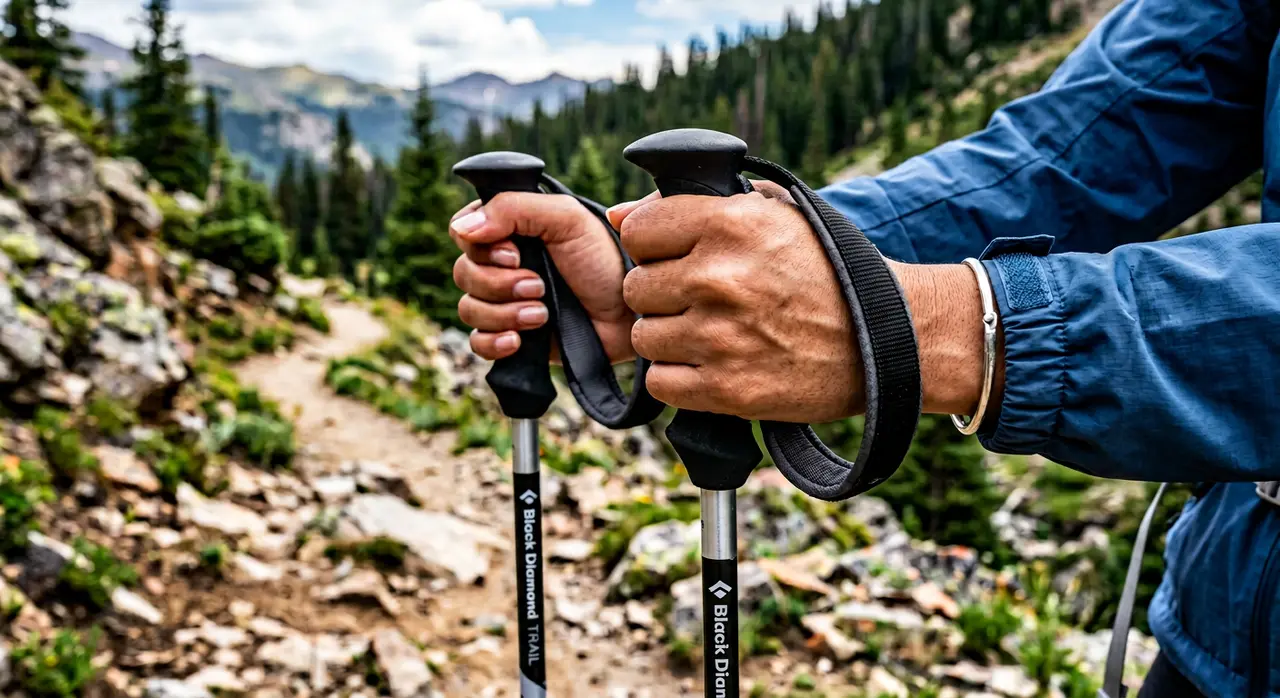
The correct method: approach the strap from below. Slide your hand up through the loop from underneath, then let the strap rest across the back of your hand and between your thumb and forefinger as you grip the handle. Now when you plant the pole and push down, the strap carries most of the downward force, not your grip. Your hand is essentially just steering, not bearing load.
Why does this matter? With proper strap technique, you can push down on the pole during the plant phase and then release your grip almost entirely during the swing-forward phase. Your hand relaxes, your forearm relaxes, and hand fatigue drops dramatically over a long day. With wrong strap technique, you're gripping hard all day and your hands cramp up by mile 6.
One exception: in steep scrambling sections or on slick creek crossings where you might need to drop a pole quickly, loosen the strap or remove your hand entirely so you don't get dragged if a pole catches on something.
Uphill Technique
Going uphill, your poles become climbing tools. Shorten them as described above, then plant both poles slightly ahead of your body with each step, not beside you, not behind you. Think of the poles as helping you pull yourself up the slope, not just providing balance.
Use opposite arm and leg together: right pole plants as left foot steps forward, left pole plants as right foot steps forward. This cross-body movement mirrors natural walking biomechanics and engages your core. If you're planting both poles at once and hopping up with both feet, you're working harder than you need to and putting unnecessary strain on your lower back.
On very steep pitches, you can use a double-plant technique: plant both poles at the same time, push down hard, and step up. This works well in short bursts on punishing switchbacks but fatigues your arms faster than single-plant technique on sustained climbs.
Keep your wrists neutral, don't bend them up or down sharply when you plant. Bent-wrist planting leads to tendinitis on long trips. Your forearm and pole should form a nearly straight line at the moment of ground contact.
Downhill Technique
Downhill is where poles earn their keep and where proper technique makes the biggest difference for your knees. Lengthen the poles 5–10 cm past your flat-terrain setting. Now you're planting them ahead of and below your position on the slope, essentially catching yourself before the step rather than after it.
The sequence: plant both poles ahead of you, step forward between them, absorb impact by letting your elbows flex slightly as your foot lands. The pole absorbs part of the impact that would otherwise travel up through your ankle, knee, and hip. On steep descents, think of yourself as having four legs instead of two.
Resist the temptation to lean back when descending. Leaning back puts your center of gravity behind your feet, which makes slipping more likely and forces your quadriceps to work much harder to prevent you from falling forward. Keep your weight centered over your feet and let the poles provide forward security. Lean slightly into the hill, it feels counterintuitive but it's correct.
On loose terrain like gravel or scree, plant poles deliberately before each step rather than using a flowing rhythm. Test the ground, transfer weight, step. Two contact points on unstable ground before you commit your foot to the next step.
Flat Terrain and the Proper Hiking Rhythm
On flat trails, most people either carry their poles at their sides uselessly or plant them randomly with no particular rhythm. Neither gets you much benefit. The right approach is a walking rhythm: opposite arm and leg move together, just like when you swing your arms naturally while walking. Right foot forward, left pole plants. Left foot forward, right pole plants.
This rhythm propels you forward slightly with each pole plant and keeps your upper body engaged. On flat terrain you don't need to push hard, a light touch is enough to improve balance and maintain the cross-body rhythm that makes hiking feel natural. If you find yourself breaking rhythm or planting both poles at once on flat ground, slow down slightly until the rhythm feels automatic, then speed back up.
River Crossings and Scrambling
On river crossings, poles are potentially the most valuable safety tool you have. Use them as third and fourth contact points, test the riverbed before committing your weight, and angle them upstream so the current doesn't sweep them (and you) downstream. For crossings above knee depth, unclip your pack's hip belt and sternum strap before crossing so you can shed the pack if you fall.
For scrambling on rock, anything where you need your hands, collapse your poles and strap them to your pack. Poles catch on rock features at the worst possible moment and can throw off your balance. On exposed ridgelines or technical Class 3+ terrain, stow the poles every time. The time it takes to attach them to your pack is worth the security of having both hands free for balance and holds.
Carbon Fiber vs. Aluminum: Which Poles to Buy
The material choice comes down to weight vs. durability vs. budget.
Carbon Fiber Poles
Carbon fiber poles are 20–30% lighter than aluminum and dampen vibration better, which reduces arm fatigue on long days. Black Diamond Distance Carbon, Leki Micro Vario Carbon, and REI Co-op Flash Carbon are reliable picks. The tradeoff: carbon doesn't bend under stress, it shatters. If you lean on a carbon pole on a steep scramble and it hits a rock at a bad angle, it can snap. Carbon poles are ideal for trail running, fastpacking, and anyone counting every ounce. Budget: $120–$200 per pair.
Aluminum Poles
Aluminum poles bend rather than break, making them more durable for heavy use, bushwhacking, and technical terrain. Black Diamond Trail Ergo Cork and Leki Corklite are workhorses that hold up to years of heavy use. They're heavier by a few ounces but far more forgiving if you accidentally torque them on a tricky move. For most backpackers and weekend hikers, aluminum is the smarter choice. Budget: $60–$130 per pair.
Folding vs. Telescoping
Folding (Z-pole) designs collapse into three sections and pack very small, great for trail running and hikes where you'll be stowing poles frequently. The downside: most Z-poles have limited length adjustment (if any), so fit matters on purchase. Telescoping poles collapse by sliding sections and lock at any length, more versatile for varied terrain and multiple users but slightly bulkier when packed.
Common Mistakes to Stop Making
- Using the strap wrong: Threading your hand down from the top means the strap does nothing. Thread up from below.
- Never adjusting height for terrain: Set your poles at one height and leave them all day and you're leaving most of the benefit on the table. Adjust for uphill and downhill.
- Planting poles too far back: Poles planted beside your hip or behind you push you sideways, not forward. Always plant ahead of your leading foot.
- Gripping too hard: White-knuckle gripping fatigues your forearms and hands in under an hour. Use the strap and let your hand relax.
- Using poles on rock scrambles: Poles on technical terrain are a liability. Stow them any time you need your hands.
- Wrong rhythm on flat terrain: If you're planting both poles at the same time on a flat trail, you're working against your natural biomechanics. Opposite arm and leg, always.
How to Use Hiking Poles Correctly FAQs
Stand on flat ground and hold the grip with the tip touching the ground beside your foot. Your elbow should be bent at exactly 90 degrees. For uphill, shorten each pole by 5–10 cm to keep the correct angle as the ground rises. For downhill, lengthen by 5–10 cm so you can plant ahead and below you on the slope. On a traverse, shorten the uphill pole and lengthen the downhill pole.
Two poles provide the most benefit, better balance on all terrain, more even weight distribution between upper and lower body, and up to 25% reduction in knee load on descents. One pole is better than none on moderate terrain, but two poles is the correct setup for any serious hike with elevation change.
Thread your hand up through the wrist strap from below, not down from the top. Let the strap rest across the back of your hand and between thumb and forefinger. The strap should carry most of the downward force during a pole plant. Your grip should be light, fingertips, not a fist. This dramatically reduces hand and forearm fatigue over a long day.
Yes, research shows poles reduce the compressive load on your knee joints by up to 25% on descents. The benefit is highest on steep, extended downhills. If you have existing knee issues, poles are not optional, they are essential. Even with healthy knees, the cumulative reduction in joint stress over thousands of feet of descent is significant.
Carbide tips handle most hard and mixed surfaces well. Use rubber tip covers on pavement, wooden boardwalks, or in mountain huts to protect surfaces and reduce noise. Attach a larger snow basket in winter or when hiking in soft alpine terrain where the narrow tip would sink in. Most poles come with a small summer basket already installed.
Stow poles on any terrain where you need your hands, Class 3+ scrambling, exposed ridge moves, steep rock with holds. Poles catch on rock features and can throw off your balance at exactly the wrong moment. Also remove from wrists at river crossings deeper than thigh-height, and unclip your pack hip belt before any crossing so you can shed the pack if you fall.