How We Picked These Boots
Every boot on this list has been worn on actual trails, not just around a parking lot. We tested on wet Pacific Northwest forest paths, loose desert scree, and snow-covered alpine routes. The criteria: support-to-weight ratio, waterproofing durability (not just day one), outsole grip on wet rock, and whether the boot actually fits a real human foot out of the box.
One honest caveat upfront: there is no single best hiking boot. A boot that's perfect for a day hike in Shenandoah would be overkill on a flat Florida trail and totally inadequate for a 3-day Cascade ridge traverse. This guide is organized by use case so you can find what actually fits your hiking.
Best Overall: Salomon X Ultra 4 GTX
The Salomon X Ultra 4 GTX is the closest thing to a universal day-hiking boot that exists. It's light enough (around 900g per pair) that you won't hate yourself at mile 8, stiff enough to handle rocky terrain without ankle flex drama, and the Gore-Tex lining holds up through real rain, not just puddle hops.
The Contagrip MA outsole is legitimately good on wet rock, one of the stickier compounds in the non-technical hiking space. Salomon's SensiFit lacing system wraps the foot properly without creating pressure points. The main complaint: the toe box runs narrow, which is a real problem if you have wider feet. Try before you buy, or size up half a step and add an insole.
Best for: Day hikes, weekend trips, variable terrain. Weight: ~900g/pair. Price: ~$165.
Best Lightweight Boot: Hoka Speedgoat 5 GTX
Hoka's Speedgoat line started as a trail runner but the GTX version with its Gore-Tex lining and slightly more structured collar makes it a legitimate lightweight hiking boot for people who hate feeling like they're wearing bricks. At under 700g per pair it's on the light end of the boot category, closer to a trail runner with ankle support than a traditional boot.
The Vibram Megagrip outsole is the best sticky rubber compound in this category. On wet granite or muddy switchbacks, it grips where other boots slide. The maximal cushioning is polarizing, some hikers love it on long days on hard surfaces, others find it reduces trail feel on technical terrain. If you're doing high-mileage days on maintained trails, this is the boot.
Best for: Long-distance day hikes, hikers with knee issues who need cushion, fast-and-light trips. Weight: ~680g/pair. Price: ~$200.
Best for Backpacking: Lowa Renegade GTX Mid
The Lowa Renegade has been a backpacker's standard for twenty years for a reason: it breaks in fast, holds up for hundreds of miles, and provides genuine ankle support under a loaded pack. The DuraPU midsole doesn't compress out like foam does over repeated heavy-load miles, and the Vibram Evo outsole handles everything from loose gravel to wet roots.
It's not the lightest option (around 1,050g per pair) and it's not cheap (~$240), but this is the kind of boot that gets resoled twice before it gets retired. The fit is notably more accommodating in the toe box than Salomon, better for wider feet. The Gore-Tex lining has proven more durable over seasons of real use than budget GTX boots.
Best for: Multi-day backpacking trips with heavy packs, hikers with wide feet. Weight: ~1,050g/pair. Price: ~$240.
Best Budget Boot: Merrell Moab 3 Mid GTX
The Merrell Moab is the boot that introduced millions of people to hiking footwear, and the third generation is the best version yet. At around $165 it's at the lower end of the waterproof boot price range, and it delivers honest value: decent waterproofing, adequate ankle support, and a comfortable out-of-the-box fit that doesn't require two weeks of breaking in.
The Vibram TC5+ outsole is solid on dirt and gravel though it loses confidence on wet rock compared to the Megagrip on the Hoka. The midsole cushioning is comfortable but compresses relatively quickly, heavy hikers or people doing very long miles will notice degradation sooner than with premium options. Still, for the price, nothing else comes close.
Best for: Beginners, occasional hikers, budget-conscious buyers. Weight: ~900g/pair. Price: ~$165.
Best for Technical Terrain: Scarpa Zodiac Plus GTX
If your hikes involve scrambling, off-trail navigation, or routes that require more foot placement precision than a well-maintained trail demands, the Scarpa Zodiac Plus GTX is the right call. It's stiff, intentionally so, with a rand that protects the upper on rock edges and a Vibram Drumlin outsole tuned for precise edging on technical ground.
It is not comfortable for casual hiking. It's heavy (~1,100g/pair), the break-in period is real, and it costs over $300. But for the hiker doing off-trail scrambling in the Sierra or technical routes in the Cascades, it's the right tool. Think of it like a mountaineering boot lite, more approachable than double-plastic boots but far more capable than any of the others on this list.
Best for: Off-trail scrambling, technical alpine day hikes, mountaineering approach routes. Weight: ~1,100g/pair. Price: ~$320.
Hiking Boots vs. Trail Runners: Which Should You Buy?
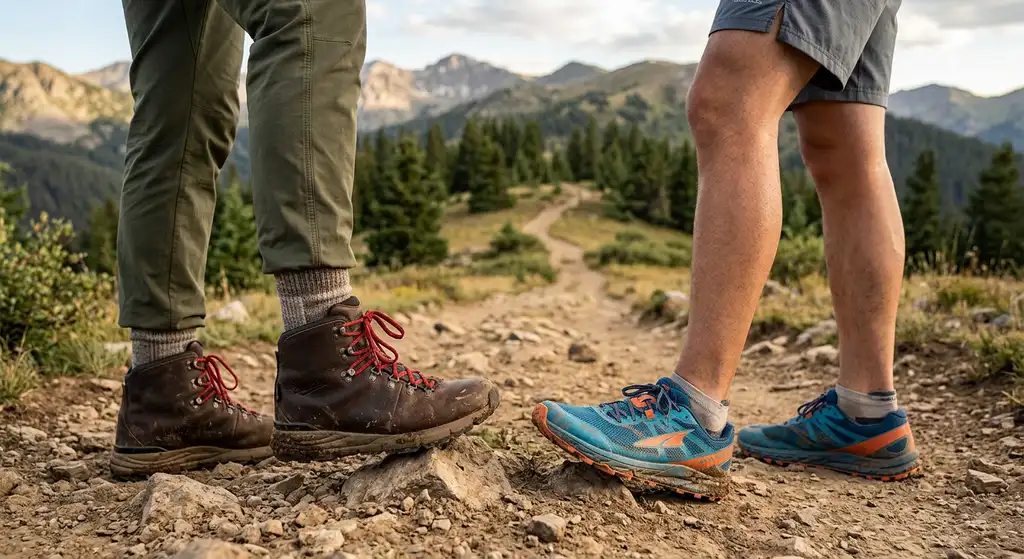
This is the most common question in hiking footwear, and the honest answer is that for most day hikes on maintained trails, a well-fitting trail runner performs as well or better than a traditional hiking boot. Trail runners are lighter, dry faster when wet, and generally have more responsive cushioning.
Where boots win: heavy pack loads (ankle support matters more with 40+ lbs on your back), technical terrain where a stiffer sole helps, cold/wet conditions where waterproofing and insulation matter more, and for hikers who have existing ankle instability issues. If you're backpacking with a real pack, or if your trails involve sustained technical sections, get boots. If you're doing mostly day hikes on good trails, a trail runner like the HOKA Speedgoat (non-GTX) or Salomon Speedcross will likely serve you better.
Waterproof vs. Non-Waterproof
Gore-Tex and similar waterproof membranes keep water out, but they also reduce breathability and take longer to dry if water does get in (over the collar, or through extended submersion). In hot, dry conditions, waterproof boots make your feet sweat more than non-waterproof versions of the same boot.
The practical guidance: if you hike primarily in the Pacific Northwest, Northeast, or anywhere with regular rain and wet trails, get waterproof. If you hike mostly in the Southwest or in summer in dry climates, the non-GTX version of your chosen boot will be more comfortable and perform better. The exception is shoulder seasons (spring/fall) anywhere, wet conditions enough to justify the membrane.
How to Get the Right Fit
Boots should be tried on in the afternoon when your feet are slightly swollen from daily activity. Wear the socks you'll actually hike in (not dress socks). When laced, you should be able to wiggle your toes freely but your heel should not lift when you flex your foot. Walk down a slope (most good outdoor retailers have a ramp for this), your toes should not hit the front of the boot.
If a boot causes hot spots or pressure points in the store, it will cause blisters on the trail. Don't buy uncomfortable boots expecting to break them in, modern hiking boots don't require the torture-break-in period that old leather mountaineering boots did. The right boot should feel right within a few minutes of putting it on.
Best Lightweight Hiking Boots: Reviews for Every Trail FAQs
Most quality hiking boots last 500–1,000 miles before the midsole loses meaningful cushioning and support. Heavy hikers or those doing sustained steep terrain may see compression sooner. Signs of wear: noticeable reduction in cushioning, outsole lugs worn down, upper delamination. High-end boots like the Lowa Renegade can be resoled to extend life significantly.
It depends on where you hike. Waterproof boots (Gore-Tex) are worth it if you hike in wet climates (Pacific Northwest, Northeast) or in shoulder seasons. In dry climates or summer, non-waterproof boots breathe better and keep feet cooler. If you cross streams regularly, waterproof boots offer minimal benefit, water will get in over the collar.
Neither. Your heel should be locked in with no lift, your midfoot should feel snug, and your toes should have a full thumbnail's width of space in front. Too tight causes blisters and black toenails on descents. Too loose causes heel blisters and reduces ankle support. Always try boots in the afternoon when feet are at their largest.
Low-cut boots are essentially trail runners with stiffer soles, good for day hikes on maintained trails. Mid-cut boots provide moderate ankle support and are the most versatile option for day hikes and light backpacking. High-cut boots offer maximum ankle support and are best for heavy packs, technical terrain, or hikers with ankle instability.
Yes, and for most backpacking trips with a loaded pack (over 30 lbs), boots are the right choice over trail runners. The key is choosing a boot stiff enough to support the load, the Lowa Renegade and Salomon X Ultra 4 GTX both work well for backpacking. Avoid very lightweight trail-hybrid boots under a heavy pack.