Why Your Knees Hurt on the Trail
Knee pain while hiking almost always comes from the descent, not the climb. When you walk downhill, your knee absorbs 3–4 times your body weight with every step. The patellofemoral joint, the joint between your kneecap and thighbone, takes the brunt. When this is overloaded repeatedly, the result is patellofemoral pain syndrome, sometimes called "hiker's knee" or "runner's knee." The pain typically feels like a dull ache below or around the kneecap, often worse going downstairs after a hike.
The good news: hiker's knee is largely preventable with the right technique, gear, and conditioning. Here's what actually works.
Downhill Technique: The Single Biggest Factor
Most hikers default to a heel-strike descent, stepping out in front of the body with a straight leg and letting the heel catch the fall. This is exactly what destroys knees over miles and years. The correct technique: shorten your stride, bend your knees slightly, and land midfoot with your foot closer to directly below your hips. Think of it as controlled descent rather than falling forward. Your quads should feel the load, not your knees.
Switchback where possible. Traversing across a slope (zigzagging rather than going straight down) dramatically reduces the per-step load. Many experienced hikers traverse naturally on steep terrain, if you see them doing it, they're protecting their joints, not being inefficient.
Trekking Poles: Non-Negotiable on Steep Descents
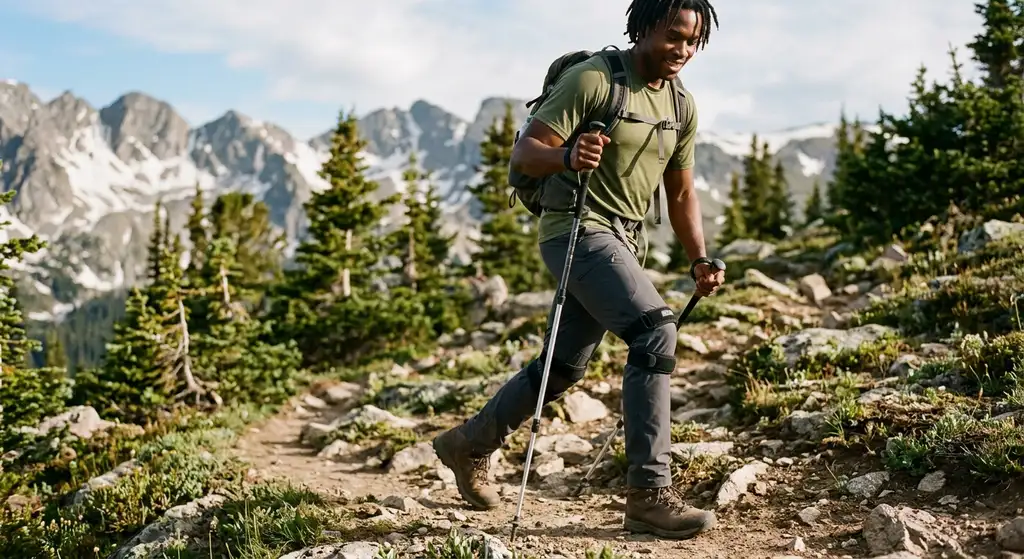
Trekking poles reduce the impact on each knee by up to 25% on steep descents. The technique: plant both poles slightly ahead on downhill sections, keep them short enough to create resistance (many hikers extend them too long, which reduces effectiveness), and use your arms to absorb some of the load that would otherwise go into your knees. Adjust pole height, lengthen slightly for descent, shorten for ascent.
If you only use poles sometimes, use them on the way down. The ascent load on knees is far lower; the descent is where the damage accumulates.
Strengthening Your Knees for Hiking
Weak quads and glutes are the underlying cause of most hiker's knee. The quad acts as a shock absorber; when it fatigues, the kneecap tracks incorrectly and pain starts. The two most effective exercises for preventing hiking knee pain:
Step-downs: Stand on a step or curb. Slowly lower the opposite heel toward the ground while bending the standing leg. Control the descent, 3 seconds down. This is the most specific exercise for the eccentric quad control that hiking descents demand. Do 3 sets of 10 each leg, 3× per week.
Single-leg squats (pistol progressions): Stand on one leg and squat as low as you comfortably can while keeping your knee tracking over your second or third toe. Poor hip alignment is often a contributor to knee pain; single-leg squats address both knee and hip strength simultaneously.
Strong glutes reduce knee stress by maintaining hip alignment on uneven terrain. Include deadlifts, hip bridges, and lateral band walks in your training.
Footwear and Insoles
Trail shoes or boots with adequate cushioning reduce impact. Look for shoes with 4–6mm drop (lower than running shoes, higher than zero-drop). Maximalist cushioning (like Hoka trail shoes) helps many hikers with knee pain by absorbing shock that would otherwise transmit to the joint.
Over-the-counter insoles with arch support can also help if you pronate (your arch collapses inward on foot strike). Rolling inward increases the torque on the knee. A neutral or slight arch correction often relieves knee pain with no other changes needed.
Fit matters more than brand. A shoe that allows your toes to spread and doesn't constrict the midfoot is more important than any specific technology.
Knee Braces and Kinesiology Tape
Patellar tracking braces (with a donut-shaped opening for the kneecap) help some hikers by keeping the patella aligned. They're not a cure but provide enough support to complete hikes while you build strength. Kinesiology tape applied from below the kneecap to the lower quadriceps provides proprioceptive feedback and mild support, many hikers use this preventively on long descents.
Neither braces nor tape substitutes for the strength and technique work above. Use them as tools while building the underlying capacity.
When to Stop Hiking and See a Doctor
Normal muscle fatigue is expected. Knee pain that warrants stopping: sharp pain rather than dull ache, pain on both sides of the knee (possible IT band syndrome, different from patellofemoral issues), swelling that develops during or after the hike, or pain that gets worse with every mile rather than holding steady. Acute swelling after a single hike can indicate a meniscus or ligament issue that needs imaging.
Persistent pain after 2–3 weeks of rest is worth a sports medicine evaluation. Most hiking knee pain responds well to a structured physical therapy program within 6–8 weeks.
Hiking Knee Pain Prevention: Complete Guide for Hikers FAQs
Downhill hiking loads the patellofemoral joint at 3–4× body weight per step, far more than flat or uphill walking. The eccentric (lengthening) quad contraction required for controlled descent is where the stress concentrates. Weak quads that fatigue early make this worse.
Yes, significantly. Research shows poles reduce knee impact by 20–25% on steep descents. The key is using them correctly: plant ahead on descents, keep them short enough to resist your weight, and actively push down to transfer load to your arms.
Hiker's knee (patellofemoral pain syndrome) is pain around or behind the kneecap caused by the kneecap tracking incorrectly under load. With rest and appropriate strengthening, most cases resolve in 4–8 weeks. Ignoring it and continuing to hike heavy descents typically makes it worse.
Light flat hiking is usually fine. Steep descents with significant pain will prolong recovery. If you must hike, use poles, shorten your stride dramatically, and descend more slowly. Pain that increases during the hike means stop, you're causing more damage.
Step-downs (slow eccentric single-leg squats from a step) are the most specific exercise for the muscles that protect knees on descents. Combined with regular single-leg squats, hip bridges, and lateral band walks for glute strength, this addresses the root cause for most hikers.