Yellowstone National Park Top Sights, Ranked by a Guide
Yellowstone national park top sights split cleanly across the Grand Loop Road: Old Faithful and Grand Prismatic Spring on the lower loop, Mammoth Hot Springs and Lamar Valley on the upper loop, and the Grand Canyon of the Yellowstone and Hayden Valley connecting the two. Nobody sees all twelve of the sights below in one day. Three days, one per loop plus a slow morning at Old Faithful, is the trip that actually works. Our Yellowstone 3-day itinerary is built around exactly that split.
Yellowstone Top Sights, Ranked
| # | Sight | Area / Loop | Time to Budget |
|---|---|---|---|
| 1 | Old Faithful | Upper Geyser Basin, Lower Loop | 1 to 2 hours, to catch an eruption and walk the basin |
| 2 | Grand Prismatic Spring | Midway Geyser Basin, Lower Loop | 45 minutes, more with the overlook hike |
| 3 | Grand Canyon of the Yellowstone | Canyon Village, connects both loops | 1.5 to 2 hours for both rims |
| 4 | Mammoth Hot Springs Terraces | North entrance, Upper Loop | 45 minutes to 1 hour |
| 5 | Lamar Valley | Northeast, off the main loop | Half a morning for wildlife watching |
| 6 | Norris Geyser Basin | Junction of both loops | 1 hour |
| 7 | Hayden Valley | Between Canyon and Lake, Lower Loop | 30 to 60 minutes, mostly from the car |
| 8 | Yellowstone Lake and West Thumb | Lower Loop | 30 to 45 minutes |
| 9 | Mount Washburn | Upper Loop, near Dunraven Pass | Half day if you hike it, 15 minutes for the pass overlook |
| 10 | Tower Fall | Tower-Roosevelt, Upper Loop | 20 minutes |
| 11 | Fountain Paint Pot | Lower Geyser Basin, Lower Loop | 20 to 30 minutes |
| 12 | Old Faithful Inn | Next to Old Faithful | 20 minutes to walk the lobby |
1. Old Faithful
Old Faithful erupts every 44 to 120 minutes, averaging about 92 minutes apart, and throws water 106 to 185 feet in the air for a minute and a half to five minutes. It is not the tallest or most predictable geyser in the park, Steamboat Geyser at Norris beats it on height, but it is the most reliable show on a schedule you can actually plan around. Check the posted prediction time at the visitor center when you arrive and use the wait to walk the rest of the Upper Geyser Basin.
2. Grand Prismatic Spring
At 370 feet across and 160 feet deep, Grand Prismatic is the largest hot spring in Yellowstone and the third largest in the world. The rings of orange, yellow, and green around the deep blue center come from heat-loving bacteria and algae living in the cooler water at the edges. You can see it from the boardwalk at Midway Geyser Basin, but the color only reads from above: the short, steep Fairy Falls overlook trail across the road is worth the extra 20 minutes for the view everyone's photos are actually taken from.
3. Grand Canyon of the Yellowstone
The canyon runs about 24 miles long and 800 to 1,200 feet deep. Lower Falls drops 308 feet, nearly twice the height of Niagara Falls, though the Yellowstone River is only 70 feet wide at the brink compared to Niagara's 2,600 feet, so the volume is nowhere close. Artist Point on the South Rim is the classic view of the falls and the yellow canyon walls the park is named for. Uncle Tom's Trail on the same rim drops close to the base of the falls on metal stairs, steep and worth it if your knees are up for the climb back out.
4. Mammoth Hot Springs Terraces
Mammoth is unlike the rest of the park's thermal features: instead of geysers, hot water carrying dissolved limestone rises here and deposits over two tons of calcium carbonate a day, building the travertine terraces in real time. The terraces change shape over months as the water shifts channels, and the colors, brown, orange, red, green, come from algae living in the flow. It is the one major thermal area near the north entrance, so it pairs naturally with a Gardiner or Mammoth overnight.
5. Lamar Valley
Lamar Valley is often called America's Serengeti, and it earns the name: it is one of the most consistent places in the world to see wild wolves, home to the Lamar Canyon and Junction Butte packs, descendants of the wolves reintroduced at Soda Butte, Crystal Creek, and Rose Creek in 1995. Bison, pronghorn, and grizzly bears are common in the same open grassland. Go at dawn or dusk with binoculars; midday is quiet.
6. Norris Geyser Basin
Norris is the hottest and oldest geyser basin in the park, and it holds Steamboat Geyser, the tallest active geyser in the world. Steamboat's major eruptions send water over 300 feet into the air, though they are unpredictable and can be months apart; its minor eruptions, around 40 feet, happen more often. Even without an eruption, the Back Basin boardwalk loop through Norris is one of the starkest, most otherworldly walks in the park.
7. Hayden Valley
Hayden Valley is an old lakebed, flat and about 7 miles across, and it draws bison, elk, grizzly bears, and wolves onto open ground where you can actually see them from the road. The valley is closed to off-trail travel to protect the habitat, so this is a drive-through and pull-over sight, not a hike. Traffic jams for bison crossing the road are normal here; budget the extra time rather than fighting it.
8. Yellowstone Lake and West Thumb
Yellowstone Lake is the largest freshwater lake above 7,000 feet in North America, 136 square miles and up to 394 feet deep, sitting at 7,732 feet. West Thumb Geyser Basin, on its shore, is the rare spot where you can see hot springs steaming right at the edge of a cold alpine lake, including Fishing Cone, an offshore spring early visitors supposedly cooked fish in without moving their line.
9. Mount Washburn
At 10,219 feet, Mount Washburn is one of the best wildlife and scenery viewpoints in the park, with a fire lookout at the summit and bighorn sheep often grazing near the trail. The hike from either the Dunraven Pass or Chittenden Road trailhead runs a half day round trip. If you do not have the time or legs for it, Dunraven Pass itself, the highest point on any road in Yellowstone at 8,859 feet, gives a version of the same view from the car.
10. Tower Fall
Tower Fall drops 132 feet through a cluster of volcanic rock spires that give the falls its name. It is a short walk from the parking area to the overlook, one of the easiest big views in the park, and a natural stop between Mammoth and Canyon on the Upper Loop.
11. Fountain Paint Pot
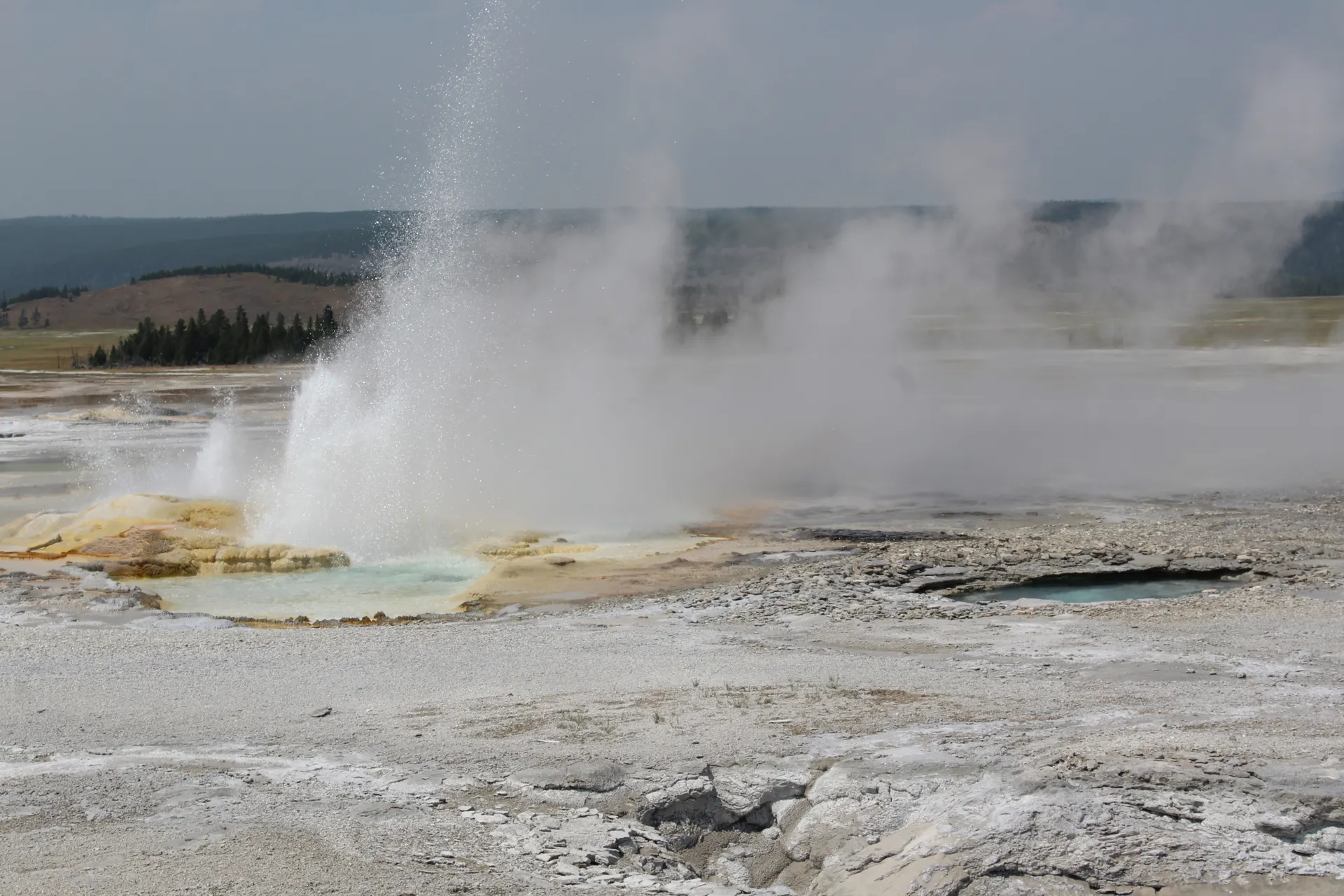
A short boardwalk loop in the Lower Geyser Basin covers all four kinds of Yellowstone thermal features in about 20 minutes: geysers, hot springs, mud pots, and steam vents. The mud pots are loudest and thickest in late summer when the ground is driest, popping and splattering like something out of a cartoon. It is the fastest way to see the full range of the park's geology if you only have one basin stop in you.
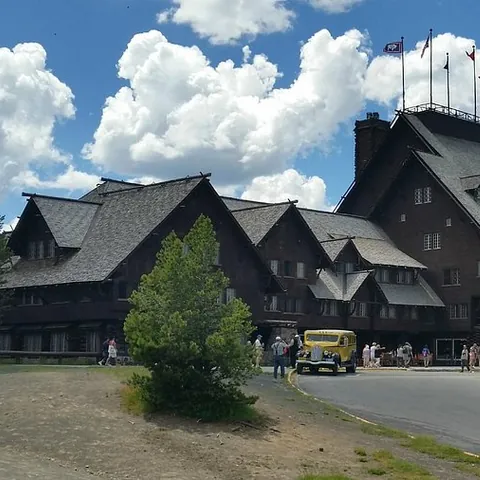
12. Old Faithful Inn
The Inn opened in 1904 and is believed to be the largest log building in the world. The lobby, seven stories of exposed lodgepole pine framing under a massive stone fireplace, is worth the walk-through even if you are not staying the night. It sits a few minutes' walk from Old Faithful itself, so fold it into the wait for the next eruption.
Plan Your Yellowstone Stops
Tell us your dates and which sights matter most to you and we will build the loop so you are not backtracking across the park to catch them. Planning is free, and we earn only if you book through us.
Keep planning with Yellowstone Upper and Lower Loop and The Best Waterfall Hikes in Yellowstone National Park.
Yellowstone National Park Top Sights, Ranked by a Guide FAQs
Watch Old Faithful erupt, see Grand Prismatic Spring from the Fairy Falls overlook, walk both rims of the Grand Canyon of the Yellowstone, tour the Mammoth Hot Springs terraces, watch wildlife in Lamar Valley and Hayden Valley, walk the Norris Geyser Basin boardwalk, stop at West Thumb on Yellowstone Lake, hike or drive up to Mount Washburn, and see Tower Fall.
Old Faithful is the sight most visitors plan their day around, since it erupts on a predictable window (44 to 120 minutes apart) rather than requiring a lucky wait. Grand Prismatic Spring and the Grand Canyon of the Yellowstone are close behind for most first-time visitors.
Three days covers the sights above at a reasonable pace: one day on the lower loop for Old Faithful and Grand Prismatic, one on the upper loop for Mammoth and Lamar Valley, and one connecting day for the Grand Canyon of the Yellowstone and Hayden Valley.
Yes. The boardwalk view from Midway Geyser Basin is close but flat, so the color pattern does not read well. The Fairy Falls overlook trail across the road adds about 20 minutes and is where the famous aerial-looking photos are actually taken.
Steamboat Geyser at Norris Geyser Basin, which can send water over 300 feet into the air during a major eruption. It is taller than Old Faithful but far less predictable, with major eruptions sometimes months apart.
Lamar Valley in the northeast corner of the park, home to the Lamar Canyon and Junction Butte wolf packs. Early morning and evening give the best odds, and a spotting scope helps since sightings are usually at a distance.
Yes. The worked day-by-day plan is Yellowstone Itinerary: 3 Days on the Grand Loop (3 Days), with the permits, the stays and the drive times already sorted. Tell us your dates and we will put it together for you and confirm what is genuinely open on those days. Asking is free: no card, no deposit, and nothing is held until you say yes.