What Is the Presidential Traverse?
The Presidential Traverse is a point-to-point ridge walk across the Presidential Range in New Hampshire's White Mountains, linking eight named summits above 4,000 feet, Mounts Madison, Adams, Jefferson, Clay, Washington, Monroe, Eisenhower, and Pierce, along with several unnamed high points on the ridge. The full traverse is approximately 23 miles, depending on exact route variations, and gains roughly 9,000 feet of elevation. It's typically done south-to-north (Valley Way trailhead in Randolph to the Crawford Notch area) or north-to-south, and is most commonly completed as either a very long single day or a two-day route using the AMC hut system.
The Presidential Range has a claim to the most severe weather conditions of any location in the continental United States, a claim backed by decades of data from the Mount Washington Observatory on the summit. The observatory recorded a 231 mph wind gust in April 1934 that stood as the world surface wind record for 62 years. Summer weather on the ridge can change from clear to whiteout conditions within 30 minutes. This isn't hyperbole, it's the foundational reality that shapes how you plan the traverse.
Route Overview
The standard south-to-north traverse begins at the Appalachia trailhead on Route 2 in Randolph, NH. Most hikers ascend via the Valley Way, which follows a protected forest route to Madison Spring Hut and the summit of Mount Madison (5,367 ft). From Madison, the ridge proper begins: a rocky, exposed route along the crest with no shelter from weather until you drop into the cols between peaks. The col between Adams and Jefferson, at around 5,100 feet, is where exposure becomes maximum, wind accelerates through the low points of the ridge and the terrain is loose volcanic rock with cairns as the primary navigation aid.
Mount Washington (6,288 ft) is the high point and the most significant summit on the traverse. The summit houses the observatory, a visitor center, a cafeteria, and year-round staff. It's accessible by a cog railway and an auto road as well as hiking, which means the summit itself is often significantly more crowded than the wilderness ridge below it. The descent from Washington south to the Lakes of the Clouds AMC hut drops 1,400 feet to 5,012 feet, still fully above treeline.
South of Washington, the terrain becomes somewhat more manageable: Monroe (5,372 ft), Franklin (5,004 ft), Eisenhower (4,761 ft), and Pierce (4,312 ft) are connected by the Crawford Path, the oldest continuously maintained hiking trail in the United States (established 1819). The traverse ends at the Crawford Notch trailhead near the Highland Center.
One-Day vs. Two-Day
Strong hikers with serious trail experience do the full traverse in a single day, typically starting before 4 a.m. and finishing 14-18 hours later depending on conditions and pace. This requires a sustained pace above 2 mph on rough terrain at altitude, with no significant weather delays. It is not recommended for anyone who hasn't previously done long, rugged, high-mileage days in similar terrain. One bad weather delay on the exposed ridge can turn a manageable 16-hour effort into a desperate slog into darkness.
The two-day option using AMC huts is the more sensible choice for most hikers. The Appalachian Mountain Club operates eight high huts in the White Mountains, two of which sit directly on the Presidential Traverse route: Madison Spring Hut (4,825 ft, between Madison and Adams) and Lakes of the Clouds Hut (5,012 ft, between Washington and Monroe). These huts provide bunks, two meals, and weather information. They are not cheap (expect $170+ per person per night for the full package in recent years) but they're transformative for the logistics of the traverse. Reservations open in the fall and popular summer dates, July and August weekends, sell out months in advance. Book early at outdoors.org.
Key Summits in Detail
Mount Madison (5,367 ft)
The northern terminus of the high ridge, typically the first major summit from the Appalachia trailhead. The summit itself is a scramble of large boulders. Madison Spring Hut sits in the col just below, providing the most protected overnight spot on the northern traverse. Views from the summit extend north into the Great Gulf Wilderness and west toward Vermont.
Mount Adams (5,799 ft)
The second highest peak in the Northeast (after Washington). The route from Madison crosses the exposed Castle Trail area before climbing to Adams. A short detour from the main ridge reaches the actual summit, which many hikers skip to stay on pace. The views from Adams in clear conditions are extraordinary, a full panorama of the northern Presidential peaks with Washington visible ahead on the ridge.
Mount Washington (6,288 ft)
The centerpiece. The summit is reached via the Gulfside Trail from Jefferson, a 4-mile exposed ridge traverse. Washington is often crowded with cog railway and auto-road visitors on the summit, which creates a surreal transition from wilderness ridge to tourist infrastructure. Use the summit's facilities (cafeteria, bathrooms, indoor weather shelter) and keep moving. The summit cone is often socked in with cloud even when the ridge below is clear, this is normal. Visibility can drop to 10 feet in thick fog, and navigation by cairn becomes critical.
Lakes of the Clouds Hut
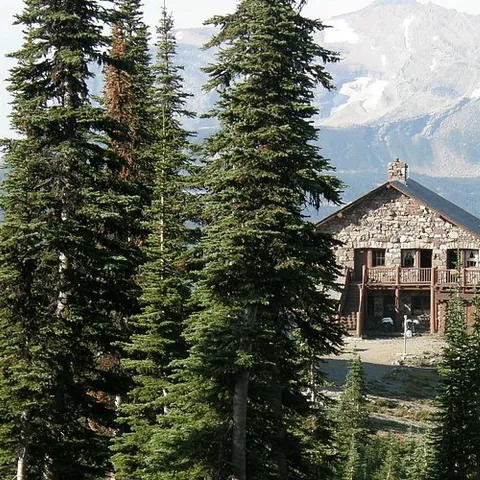
At 5,012 feet and tucked into a col between Washington and Monroe, the Lakes of the Clouds hut is the busiest in the AMC system and the most scenically situated. It sits directly above two small alpine tarns. If you're doing the traverse in two days, this is the logical second-night stop before finishing south. Reserve well in advance.
Weather: The Non-Negotiable Factor
The rule on the Presidential Range is simple: never commit to the exposed ridge without a solid forecast and the mental willingness to turn around. Check the Mount Washington Observatory forecast (mountain-forecast.com or the observatory's own site) the night before and again the morning of your hike. The observatory provides mountain-specific forecasts that are significantly more accurate than regional weather apps. Look for wind speed at summit elevation, cloud ceiling, and precipitation probability. A forecast of 40 mph winds with clouds at 4,000 feet is a bail-out day. 20 mph winds with clear skies is a go day. Everything in between requires judgment.
Even in July and August, temperatures on the exposed ridge can drop to 35–45°F with wind chill making it feel far colder. A waterproof hard shell and a fleece layer are not optional, they're required kit regardless of the valley forecast. More hikers get into trouble from inadequate layering than from any other single equipment failure.
Gear for the Presidential Traverse
- Navigation: Paper map and compass in addition to phone with Gaia GPS downloaded offline. Above treeline in fog, you navigate by cairn, knowing which direction to travel between cairns requires actual compass ability. This is not an exaggeration.
- Layers: Moisture-wicking base layer, insulating mid-layer (fleece or down), waterproof/windproof hard shell on top. Gloves and a hat even in summer.
- Water: 3-4 liters capacity. Stream sources exist in the cols but should be filtered. The huts sell water and snacks if you're staying in them.
- Footwear: Waterproof hiking boots with ankle support. The ridge terrain is loose, rocky, and uneven, trail runners are manageable but boots are safer.
- Headlamp: Essential for early starts and long days.
- Emergency bivy: Lightweight emergency shelter in case of forced bivouac on the ridge. Not a backup plan, a safety net.
Logistics and Car Shuttles
The traverse is point-to-point, which requires either a car shuttle between the Appalachia (north) and Crawford Notch (south) trailheads, or use of the AMC hiker shuttle. The AMC operates a seasonal hiker shuttle between its facilities and key trailheads, this eliminates the car shuttle problem and is worth the fee. The Appalachia trailhead is on Route 2 in Randolph; the Crawford Notch trailhead is off Route 302 near Bretton Woods. Both have parking. The shuttle runs multiple times daily during peak season; check schedules at outdoors.org.
Best Season
July and August offer the most reliable weather windows. June is possible but often has lingering snow on north-facing slopes above 5,000 feet. September is excellent, fewer crowds, fall foliage on the lower slopes, and often stable weather with good visibility. October is possible but carry full winter layers and be prepared for ice on the summit. The traverse in winter is a serious mountaineering objective requiring ice axes, crampons, and navigation skills in potential whiteout, not a hiking trail.
Presidential Traverse Hiking Guide FAQs
Strong hikers do it in 14-18 hours as a single day push. Two days is the standard recreational approach, spending a night at Madison Spring Hut or Lakes of the Clouds Hut. Both options require advance planning, car shuttle or AMC hiker shuttle, and hut reservations for overnight.
Yes, AMC huts require advance reservations through outdoors.org. Madison Spring Hut and Lakes of the Clouds Hut serve the Presidential Traverse. Summer weekends book out months in advance. Work-for-stay options allow hikers to do chores in exchange for a bunk and breakfast if bunks are full, inquire at the hut on arrival.
It can be. The primary hazard is weather, rapidly changing conditions, extreme wind, lightning, and fog on exposed ridges above 5,000 feet. The secondary hazard is navigation difficulty in low visibility. With a solid forecast, proper gear, and the ability to turn around, it's manageable. Without those, it's genuinely dangerous.
Not the full traverse. Individual summits on the Presidential Range (like Mount Pierce or Eisenhower) are accessible to strong beginner hikers via the Crawford Path. The full traverse requires significant prior experience on technical, high-mileage, high-altitude terrain, at minimum 10+ miles with 3,000+ feet of gain on rugged trails.
Tuckerman Ravine Trail from Pinkham Notch is the classic day-hike route to Washington's summit, 8.4 miles round-trip, 4,200 feet gain. It climbs through the headwall of Tuckerman Ravine, a glacial cirque famous for spring skiing. Hard and direct, but the most rewarding single-day route to the summit.