What Leave No Trace Actually Means
Leave No Trace (LNT) is a set of outdoor ethics developed collaboratively by the Leave No Trace Center for Outdoor Ethics, the US Forest Service, National Park Service, and Bureau of Land Management. It's not a set of rules, no ranger is going to ticket you for stepping off trail or cooking in your campsite. It's a decision-making framework: a way of thinking about your impact on wild places so that your presence doesn't degrade them for the people and wildlife that come after you.
The reason this matters now more than it did twenty years ago is scale. Outdoor recreation participation has exploded, the pandemic alone added millions of new hikers to American trails. Some of the most beloved wilderness areas in the country are being genuinely damaged by the cumulative impact of well-intentioned visitors who don't know any better. Understanding and practicing LNT isn't elitism, it's the minimum standard for responsible use of shared public land.
Here are the 7 principles, with practical application for day hikers and backpackers.
1. Plan Ahead and Prepare
This principle gets glossed over because it sounds administrative. It's actually the most consequential, poor planning creates most of the impacts that other principles are trying to prevent.
Planning ahead means: knowing the regulations for the area you're visiting (fire restrictions, group size limits, permit requirements, camping zones). It means downloading your trail map offline before you go so you don't need cell service. It means packing food in reusable containers instead of single-use packaging that generates waste on trail. It means knowing where water sources are so you're not filtering from marginal sources. It means having a turnaround plan so you don't end up hiking out in the dark and trampling vegetation off trail.
Well-prepared hikers make fewer improvised decisions on trail. And improvised decisions, building an unauthorized fire ring, camping in an undesignated spot because you ran out of daylight, cutting switchbacks because you didn't know the route, cause most of the damage that LNT is designed to prevent.
2. Travel and Camp on Durable Surfaces
Stay on the trail. This sounds obvious but it requires active attention on social trails, those user-created spur trails that cut switchbacks, shortcut to overlooks, or loop around muddy sections. Every time someone steps off trail on fragile vegetation, it damages the plants and compacts the soil. Repeated use turns a single step into a new trail. The social trails spreading out from every popular viewpoint in Zion, the Enchantments, and the Maroon Bells exist because thousands of people made the same small decision.
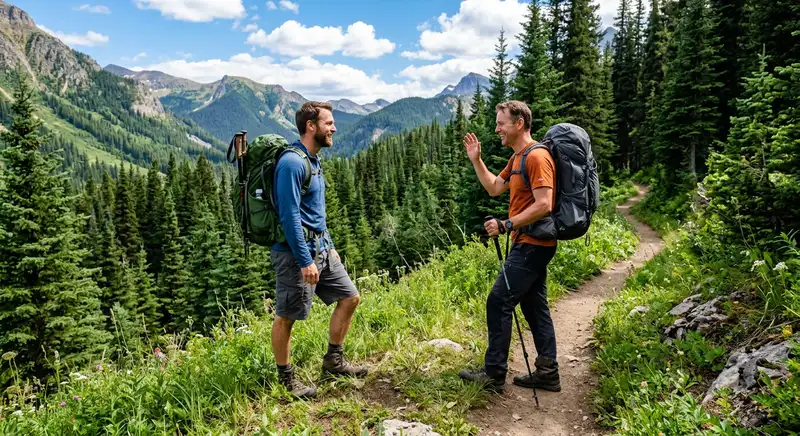
Walk single-file on trail in your group rather than spreading out. If you have to step off trail, disperse your group across durable surfaces, rock, gravel, dry grass, or snow, rather than everyone walking the same line and creating a new trail.
At camp, choose designated sites where available. In dispersed camping areas (National Forests, BLM land), camp at existing bare-soil sites rather than on new vegetation. Camp on rock or gravel where possible. Set up your tent on previously impacted surfaces rather than on pristine ground. In high-use alpine areas, look for sites that are already impacted, adding impact to a used site is better than creating a new one.
The general rule for dispersed camping is 200 feet (about 70 adult steps) from water sources, trails, and other campsites. This distance protects water quality and gives wildlife access to water sources without human disturbance.
3. Dispose of Waste Properly
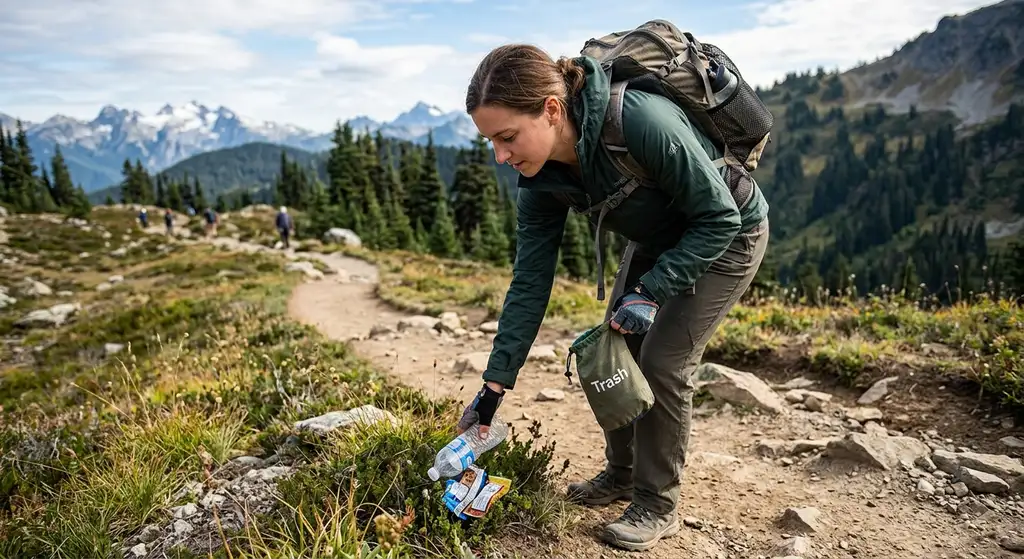
Pack it in, pack it out. Every piece of trash you bring onto a trail comes back with you. This includes food scraps, apple cores and banana peels don't decompose quickly in dry climates and attract wildlife. Orange peels take months to decompose and their bright color stands out as litter on trail.
Human waste is the most complex waste disposal issue in backcountry use. In developed campgrounds and most day-use areas, use established restroom facilities. In the backcountry:
- Urinate at least 200 feet from water sources, trails, and camps. On rock or in soil away from vegetation.
- For solid waste, dig a cathole 6–8 inches deep and 6 inches wide, at least 200 feet from water, trails, and camps. After use, cover and disguise it. In some high-use areas (Grand Canyon river corridor, Mount Whitney, many alpine zones), pack-out systems are required, carry a WAG bag or similar waste containment bag.
- Pack out used toilet paper rather than burying it. Buried TP degrades slowly in dry climates and gets dug up by wildlife. Double-bag it in your waste bag or use a small dedicated toilet waste bag.
Wash yourself and dishes at least 200 feet from water sources, using biodegradable soap (Dr. Bronner's, Sea to Summit Wilderness Wash) in minimal quantities. Scatter strained dishwater broadly rather than dumping it in one spot.
4. Leave What You Find
Don't take rocks, plants, antlers, feathers, or any natural objects from public lands. This applies even to things that seem abundant, beautiful stones, wildflowers, shed antlers. When millions of people make exceptions for "just one small thing," the cumulative impact is significant. Many plants in alpine and desert environments are extremely slow-growing, a flower you pick may have taken 20 years to bloom.
Don't build rock cairns beyond those placed by trail crews for navigation. The trend of stacking decorative cairns has become a genuine problem in places like Acadia and Arches, they confuse navigation markers and disturb ecosystems. Don't move rocks, logs, or other natural structures around camp to create furniture or fire rings.
Leave cultural artifacts, arrowheads, pottery shards, petroglyphs, where they are. Removing cultural artifacts from public land is a federal crime under the Archaeological Resources Protection Act. Disturbing or touching petroglyphs can damage them permanently.
5. Minimize Campfire Impacts
Campfires have significant impact on wilderness areas, they leave fire rings, consume wood that would otherwise decay and support the ecosystem, and can escape control. In many areas, they're restricted or prohibited entirely.
The LNT standard is: use a camp stove instead of a fire whenever possible. Stoves are faster, cleaner, and leave no trace. If you do build a fire, use existing fire rings rather than creating new ones. Keep fires small. Burn only down dead wood you can break by hand, not green wood, not large logs. Let the fire burn completely to ash, then drown it with water until it's cold to the touch.
Check fire restrictions before your trip. Many western states implement fire bans during dry periods, these are serious public safety measures, not suggestions. Violating fire restrictions can result in significant fines and liability if your fire escapes.
6. Respect Wildlife
The 100-yard rule applies to bears and wolves in most national parks; 25 yards for other wildlife. These aren't arbitrary numbers, they reflect the distance at which human presence causes animals to abandon behavior, flee, or become stressed. An animal that's repeatedly flushed from feeding areas by hikers burns energy it can't afford to lose, especially before winter.
Don't feed wildlife under any circumstances. This is one of the most harmful things a hiker can do. Animals that learn to associate humans with food become aggressive, lose their foraging instincts, and often have to be euthanized. "A fed bear is a dead bear" is not a cliché, it's a statement of management reality.
Store food properly in bear country. Use a bear canister (required in many zones) or hang food bags at least 10 feet off the ground and 4 feet from the tree trunk. In developed campgrounds, use the bear boxes provided. Don't leave food unattended for any length of time.
7. Be Considerate of Other Visitors
The most overlooked LNT principle is also the most immediately impactful to other people on trail. This covers: yielding to uphill hikers (they have right of way because maintaining momentum on a climb is harder than stopping on descent). Keeping noise levels appropriate to the setting, a quiet trail through a wild landscape is part of the experience, not just a backdrop. Letting natural sounds predominate rather than playing music through a speaker.
Group size matters. Large groups have disproportionate impact, on trail, at campsites, and in wildlife encounters. Most wilderness areas have a group size limit of 10–12. Keep your group together rather than spreading across a quarter-mile of trail.
Camping away from other parties respects their experience of solitude. The 200-foot rule from trails applies to campsite placement relative to other camps as well in dispersed camping situations.
Leave No Trace: The 7 Principles Every Hiker Must Know FAQs
At least 200 feet (about 70 adult steps) from any water source, trail, or other campsite. This distance protects water quality by keeping waste and foot traffic away from riparian areas, and it preserves wildlife access to water.
Yes, in most backcountry situations, especially in dry climates and high-use areas. Bury human waste in a 6-inch-deep cathole at least 200 feet from water and trails, but bag and pack out toilet paper rather than burying it. Buried TP degrades slowly, gets dug up by wildlife, and contributes to unsanitary conditions in high-traffic areas.
No. Moving rocks and logs disturbs microhabitats and the small animals that depend on them. Camp on already-impacted surfaces. Building rock cairns beyond established navigation markers is also discouraged, they confuse route-finding and displace habitat.
Many alpine and desert wildflowers take years to reach blooming size. With millions of hikers on trails, even occasional picking of common flowers has cumulative impact. In national parks, removing plants or natural objects is prohibited by federal law.
Use a camp stove instead of a fire whenever possible. If you build a fire, use an existing fire ring, keep it small, burn only down dead wood you can break by hand, and drown the coals with water before leaving. Check local fire restrictions before your trip, violations can result in serious fines.