Reading a Map of the Adirondacks NY

The Adirondack Park covers roughly six million acres of northern New York, which is larger than Yellowstone, Yosemite, Grand Canyon, and Great Smoky Mountains combined. A single state highway map will not help you hike here. What you want is a map oriented around the High Peaks Wilderness, the cluster of 46 summits over 4,000 feet that draws most backpackers. The hub for nearly all of it is the village of Lake Placid and the hamlet of Keene Valley just to the south.
On any good Adirondacks map you should be able to locate three things quickly: the trailhead parking areas, the lean-to shelters, and the wilderness boundary lines that dictate where you can and cannot camp. Once you can read those three layers, the rest of the park becomes navigable.
The Key Trailheads to Find First
Most High Peaks routes begin at one of a handful of access points. Learn these names and your map suddenly makes sense:
- Adirondak Loj / Heart Lake south of Lake Placid, the busiest gateway and the start of the Algonquin and Mount Marcy approaches.
- The Garden in Keene Valley, which feeds the Johns Brook valley and the eastern peaks like Big Slide and Gothics.
- Cascade Lakes trailhead on Route 73, the shortest legal route up Cascade Mountain.
- Upper Works near Tahawus, the quieter southern approach to Mount Marcy and the MacIntyre Range.
If you are planning a multi-day trip, our Adirondack High Peaks itinerary ties several of these access points together into a single MacIntyre Range loop with mapped daily distances.
Paper Maps Worth Carrying
Cell service is unreliable across most of the wilderness, so a paper map is not optional. The National Geographic Trails Illustrated 742 Lake Placid / High Peaks map is the standard, printed on waterproof tear-resistant stock. Many local hikers also swear by the Adirondack Mountain Club High Peaks Region map set. Both show the same trail network but differ slightly in contour detail, so plenty of people carry one of each.
Whatever you carry, mark your intended campsites and your bailout points before you leave the parking lot. The terrain drains fast after a storm and a stream crossing that looks trivial on the map can become impassable.
Digital Tools That Actually Work Offline
Download your route for offline use before you lose signal in Lake Placid. CalTopo and Gaia GPS both render the High Peaks trail layer well and let you cache tiles. The free Avenza app can load the National Geographic map as a georeferenced PDF so your blue dot appears on the same map you have in your pocket. Bring a battery bank; cold ridgelines drain phones fast even in summer.
Understanding Wilderness Zones and Camping Rules
The colored boundaries on your map are not decoration. Inside designated Wilderness areas like the High Peaks, camping is restricted to marked sites and lean-tos, and above 3,500 feet camping is banned entirely to protect fragile alpine vegetation. Group sizes are capped, and bear canisters are required in the eastern High Peaks. A map that shows the zone lines keeps you legal and keeps the alpine zone alive.
Orienting Yourself: Marcy, Colden, and the MacIntyre Range
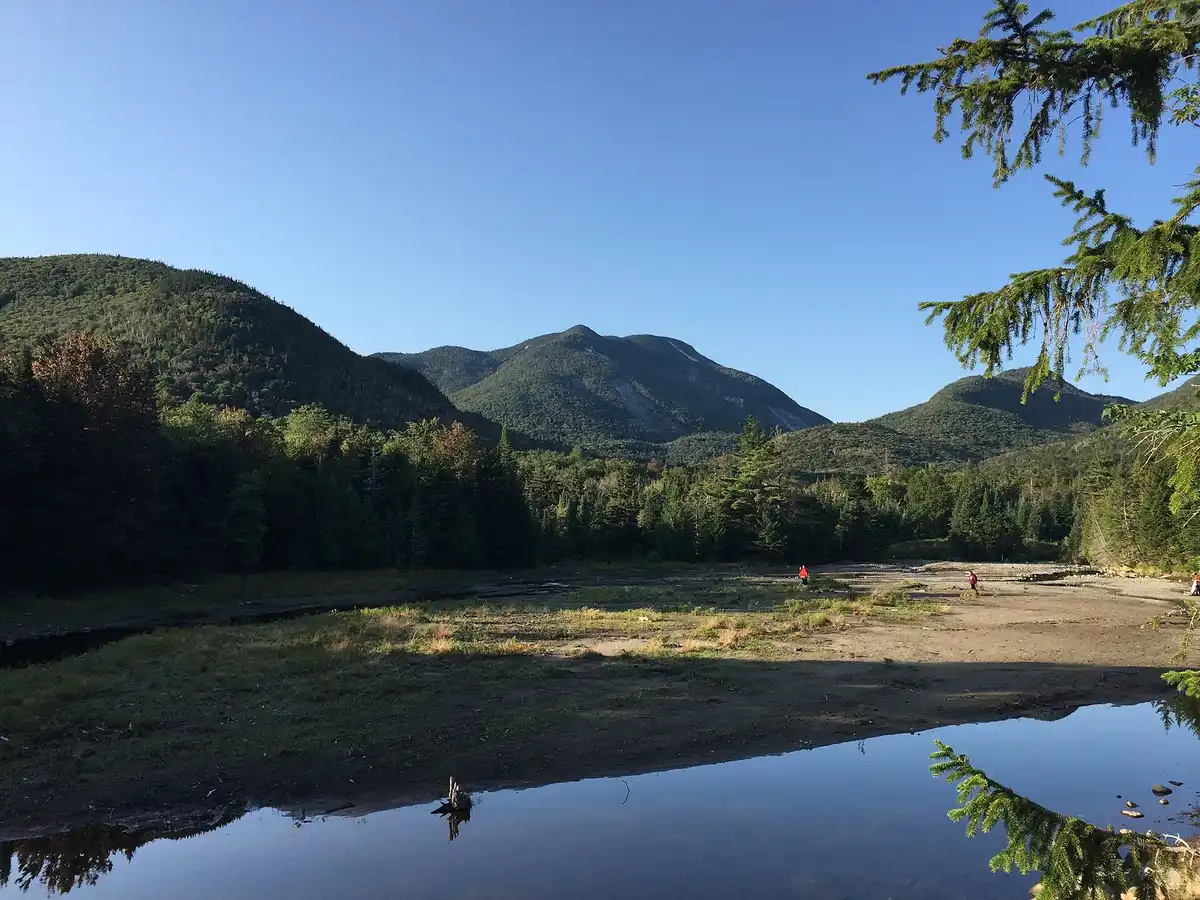
Once you can find the trailheads, anchor your mental map to the big landmarks. Mount Marcy, the tallest peak in New York at 5,344 feet, sits roughly in the center of the High Peaks Wilderness, with the deep notch of Avalanche Pass and the slide-scarred face of Mount Colden just to its west. North and west of Colden runs the MacIntyre Range, the line of summits that includes Wright Peak, Algonquin, and Iroquois. Almost every classic route radiates out from the Heart Lake and Lake Placid side, so if you keep Marcy in the middle and the MacIntyre Range to its northwest, the rest of the map clicks into place. Lakes are another reliable handrail: Heart Lake, Marcy Dam pond, Lake Colden, and Flowed Lands form a chain that many backpackers thread on multi-day loops.
Distances Are Deceiving on Adirondack Maps
A common beginner mistake is reading miles like they are flat. In the High Peaks, a 7-mile day can take eight hours because the trails climb relentlessly, cross boulder fields, and run over wet roots and slick slab. When you plan from the map, do not budget by distance alone. A useful rule of thumb here is to add an hour for every 1,000 feet of climbing on top of your flat walking pace. Note the contour lines tightening near summits, factor in stream crossings that slow you down after rain, and always pad your turnaround time so you are off the exposed alpine zones before afternoon thunderstorms build. Marking estimated times at each junction directly on your map keeps you honest in the field.
Seasons and How the Map Changes
The same map reads differently across the year. From roughly June through September the trails are open and the high water crossings are manageable. By late September the foliage peaks and parking lots fill before sunrise. From December into April those summer trails become winter routes that demand snowshoes or crampons, and several trailheads on Route 73 plow only intermittently. Snow can also bury trail markers and erase the boot path entirely, which is exactly when solid map and compass skills matter most. Always check current conditions with the New York DEC before relying on a summer map in shoulder season.
Map of the Adirondacks NY FAQs
For the High Peaks, the National Geographic Trails Illustrated 742 Lake Placid / High Peaks map is the most widely used. It is waterproof, shows lean-tos and trailheads clearly, and pairs well with offline apps like Gaia GPS or Avenza.
Mostly no. You may get a signal on a few exposed summits, but valleys and trailheads like Upper Works are dead zones. Download maps for offline use in Lake Placid and carry a paper backup.
The Adirondak Loj at Heart Lake south of Lake Placid is the busiest hub, serving the Algonquin and Marcy routes. The Garden in Keene Valley and the Cascade Lakes trailhead on Route 73 are other common starting points.