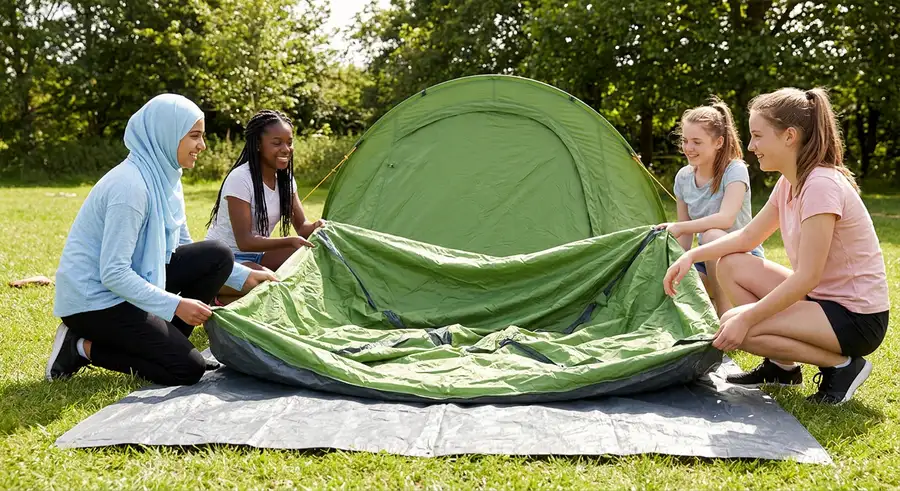
Practice at Home Before You're in the Backcountry
The single most important rule of tent setup: pitch your tent at home before your first trip with it. You want to find the broken pole sleeve, the missing stake, or the instruction sheet you can't read in the dark, before you're at 9,000 feet at dusk with rain coming in. A 15-minute practice run in your backyard eliminates 90% of camp setup problems.
This guide covers the three main tent categories: freestanding double-wall tents (the most common backpacking tent), non-freestanding tents (trekking pole setups and ultralight options), and tarps. Each has a different setup sequence and different failure points.
Before You Pick a Spot
Tent setup begins before you pull anything out of the bag. Choosing the wrong site makes every subsequent step harder and less comfortable.
- Look for flat, clear ground. Even a 3-degree slope feels significant after 6 hours of sleep. Clear rocks, roots, and pinecones, they'll puncture your groundsheet and dig into your back.
- Avoid low spots and drainage channels. Water flows downhill. A site that looks flat often collects runoff in rain. Look for slightly elevated, not depressed, terrain.
- Check overhead. Overhanging dead branches (widow-makers) are a serious hazard. Avoid camping under large trees with obvious dead limbs.
- Orient the tent door downwind. This reduces wind forcing rain into the vestibule and keeps the interior warmer. If there's no wind, orient the door away from the sunrise if you want to sleep in.
- Leave No Trace. On designated sites, use established tent pads. In dispersed camping, pitch on durable surfaces (rock, gravel, dry grass) and at least 200 feet from water sources.
Freestanding Double-Wall Tents (Most Common Setup)
This covers the majority of backpacking tents: MSR Hubba Hubba, Big Agnes Copper Spur, REI Half Dome, Nemo Hornet, and similar designs. The inner tent is supported by poles and can stand without stakes; the rain fly goes over it.
Step 1: Lay out the footprint or groundsheet
If your tent came with a footprint (custom-cut groundsheet), lay it down first. If using a generic tarp as a footprint, tuck the edges inward so they don't extend beyond the tent floor, a protruding groundsheet collects water and channels it under the tent.
Step 2: Unfold the tent body
Lay the tent body flat, door side up. Confirm you know which end is the head and which is the foot, pitching a tent backward means the vestibule is on the wrong side.
Step 3: Assemble and thread the poles
Connect all pole sections and thread them through the pole sleeves or attach to clips. Most modern tents use clips rather than sleeves, faster and allows the inner to hang freely. If your tent has sleeves, push the pole through gently, don't force it; a broken pole in the field is a serious problem.
Step 4: Stake out the corners
Before you raise the tent, stake the two base corners on the foot end. This gives you an anchor to tension against as you raise the poles. Use a Y-beam or shepherd's hook stake for soft ground, a nail stake for hard packed dirt. Drive stakes at a 45-degree angle away from the tent, not straight down, angled stakes hold far better under load.
Step 5: Insert pole tips and raise the tent
Insert both pole tips into the grommets at each corner. The tent will dome up. If your tent has two crossing poles, insert them into their respective corners on a diagonal.
Step 6: Stake remaining corners and vestibule points
Pull each remaining corner out to full tension and stake it. The tent body should be taut with no sagging fabric at the corners. Sagging = collected condensation, reduced interior space, and poor storm performance.
Step 7: Attach and tension the rain fly
Drape the rain fly over the tent body and attach the buckles or velcro tabs at the corners. Then stake out the fly corners, the fly should extend far enough from the inner tent to create an air gap. This gap is critical: without it, condensation on the cold fly transfers directly to the inner tent and your sleeping bag gets wet. Finally, stake out the vestibule pole (if applicable) and any guy lines.
Step 8: Guy out in wind or rain
In calm conditions you can skip guy lines. In wind or heavy rain, skip nothing. Attach guy lines to all available loop points and tension them out at 45 degrees from the tent. Properly guyed tents handle 50+ mph gusts; unguyed tents fail at half that speed. Reflective guy lines are worth the small weight penalty, you'll stop tripping over them at night.
Non-Freestanding Tents (Trekking Pole Setup)
Ultralight tents like the Zpacks Duplex, Six Moon Designs Lunar Solo, and Tarptent Protrail use your trekking poles as the support structure. They can't stand on their own, staking is non-negotiable.
Setup sequence
- Stake the four corners first, this is reversed from freestanding setup. The tent is limp without stakes, so you need anchors before raising anything.
- Insert your trekking poles into the pole pockets at the peak. Set pole height to match the tent's specified pitch height (usually marked or noted in the manual). Most ultralight tents pitch best at a specific height, too short and the walls sag inward, too tall and the stake points lift off the ground.
- Tension all stake points, the pitch quality of non-freestanding tents depends entirely on even, adequate tension on every stake point. Pull each one taut and adjust if any wall is touching the inner (condensation problem).
- Guy out aggressively in any wind, ultralight tents are more susceptible to wind than heavier freestanding designs. Use all guy line attachment points.
Tarps
A tarp pitched well is lighter, cooler in summer, and more versatile than a tent. A tarp pitched poorly is a wet nightmare. The two most reliable pitches are the A-frame and the lean-to.
A-frame pitch
String a ridgeline between two trees at head height. Drape the tarp over it and stake the four corners out at 45 degrees. The ridgeline takes most of the tension; the corners pull the walls taut. Pitch the windward side lower to the ground to block driving rain and wind.
Lean-to pitch
Stake one long edge of the tarp low to the ground (6–12 inches). Run the opposite edge up to a ridgeline or trekking poles at 4–5 feet. This creates a classic shelter that blocks one direction of weather beautifully but leaves the opposite side open. Best for stargazing in stable weather.
Common Setup Mistakes
- Not staking before sleeping. A freestanding tent can blow away or collapse in wind without stakes. Always stake, even in calm conditions.
- Rain fly touching the inner tent. Anywhere the fly contacts the inner tent, condensation transfers through. The air gap is what keeps the inside dry.
- Diagonal corners. If your tent corners aren't pulled to 90-degree angles, the floor bags up and the walls sag. Reposition the stake angle.
- Forgetting the seams. Many tents require you to seam-seal the stitching before first use (check your manual). Waterproof seam sealer (McNett or Gear Aid) costs $8 and takes 30 minutes, skip it and the seams will leak.
How to Set Up a Tent FAQs
Most freestanding backpacking tents take 5–10 minutes once you know the setup. First time, add 10–15 minutes. Ultralight non-freestanding tents take longer initially (10–20 min) because staking placement matters more, but experienced users can pitch them in 5 minutes.
Not always, but it significantly extends tent floor life and adds waterproofing on wet ground. On sharp gravel or rocky terrain, use one. On smooth soil or established tent pads, it's optional. You can use a light polycryo groundsheet instead of a tent-specific footprint to save weight and cost.
MSR Groundhog Y-beam stakes are the gold standard for most conditions, excellent hold-to-weight ratio, durable, and easy to pull out. For ultralight trips, titanium shepherd's hook stakes (Vargo, Toaks) save weight. Avoid thin aluminum pins, they bend on first use in anything harder than sand.
Three things: ensure the rain fly has an air gap from the inner tent, stake out the fly fully so it doesn't pool water, and minimize wet gear coming inside. Shake out wet gear in the vestibule, not the inner tent. Bring a small camp towel to wipe condensation off the inner walls in the morning.
Yes, most double-wall tents can be pitched as inner-only in fair weather for better ventilation and stargazing. The inner mesh keeps bugs out. Just watch the forecast, weather changes fast in mountains and you want the fly accessible, not stuffed at the bottom of your pack.