Start With Trip Length, Not Volume
Most people approach backpack shopping backwards, they look at a pack they like and then try to figure out if it'll work for their trips. The right approach is to start with how long your typical trips are and choose the volume range that fits, then find the best pack in that range. Volume categories map directly to trip length:
- 15–25L (daypack): Day hikes, half-day trips, summit pushes from a base camp.
- 25–40L (weekend pack): 1–3 night trips with modern lightweight gear.
- 40–55L (standard backpacking pack): 3–7 night trips, shoulder-season camping, moderate loads.
- 55–75L (expedition pack): Week-plus trips, heavy gear, winter camping, international trekking with camp gear.
If you're primarily a day hiker who occasionally does one overnight trip per season, buy a good daypack and rent or borrow a backpacking pack for the overnight. Don't compromise your everyday pack to cover a rare use case.
How Suspension Fit Actually Works
Suspension fit is the most important factor in choosing a backpack and the one most people get wrong by shopping online without trying the pack on. A backpack's suspension is the system of shoulder straps, hip belt, and frame that transfers weight from the bag to your body. A properly fitted suspension puts roughly 80% of the load on your hips and 20% on your shoulders.
Torso length is not height: Pack sizing is based on torso length, the distance from your C7 vertebra (the prominent bone at the base of your neck) to your iliac crest (the top of your hip bones). This measurement is often different from what your height would suggest. Many shorter people have long torsos and vice versa. Measure your torso before shopping.
Hip belt fit: The hip belt should sit on your iliac crest, the shelf of bone at the top of your hip. If it's sitting on your waist (above the crest), the pack is transferring weight incorrectly and will cause lower back pain. The belt should wrap around the crest with the buckle centered on your hip, not resting on your stomach.
Shoulder straps: With the hip belt properly positioned and the load lifters tightened, shoulder straps should contour your shoulders without gaps. There should be a slight gap at the top of the shoulder where the strap meets the pack, if the straps pull away from your shoulders before that point, the pack is too long for your torso. If the pack's top sits against your head or neck, it's too short.
The Real Difference Between Suspension Systems
Pack manufacturers make wildly different claims about their suspension technology. Here's what the differences actually mean in practice:
External frame packs: Almost nobody uses these anymore outside of very specific use cases (heavy loads on established trails, hunting packs). Heavy, awkward off-trail, and obsolete for most hiking applications.
Internal frame with foam/stay frame: The standard for backpacking packs. Aluminum stays or composite frames sit inside the pack against your back and transfer weight to the hip belt. Most packs from $100–$400 use this system. Quality varies significantly, cheaper stays flex under load, good ones (Osprey, Gregory, Arc'teryx) hold their shape.
Suspended mesh back panels (Osprey AirSpeed, Deuter Aircomfort): The pack frame holds the bag away from your back, with a tensioned mesh panel creating an air channel between the bag and your body. Significantly cooler in warm weather. Slight trade-off: the suspended system adds some weight and doesn't transfer load quite as efficiently as a direct-contact frame for very heavy loads (55+ lbs). For most hikers the ventilation benefit outweighs this.
Frameless packs: Used by ultralight backpackers who keep base weight under 10 lbs. The rolled or folded sleeping pad acts as a framesheet. No transfer to hip belt to speak of, all weight on shoulders. Only appropriate if your total pack weight is under 20 lbs.
Features That Actually Differentiate Packs
Hip belt pockets: Useful for trail snacks, phone, and lip balm without stopping to access the main compartment. Standard on most packs over 35L. Some daypacks include small versions. If you snack while moving, this feature matters.
Rain cover vs. waterproof construction: Most packs include a rain cover stored in a bottom pocket. These cover the bag but not the hip belt area, and they can blow off in wind. Better: line the inside of your pack with a trash compactor bag and use dry bags for sensitive items. Dyneema/Cuben fiber packs are inherently waterproof but expensive.
Bottom compartment: A separate sleeping bag compartment with a divider to the main compartment is standard on most backpacking packs. Useful for keeping your sleeping bag accessible and slightly separated from camp gear. The divider is removable in most packs if you prefer one big compartment.
Hydration compatibility: A sleeve inside the main compartment and routing ports for a hydration hose. Standard on all hiking packs now. Worth confirming the sleeve fits the reservoir brand you use, most are compatible with Platypus and CamelBak but dimensions vary slightly.
How to Try on a Pack Properly
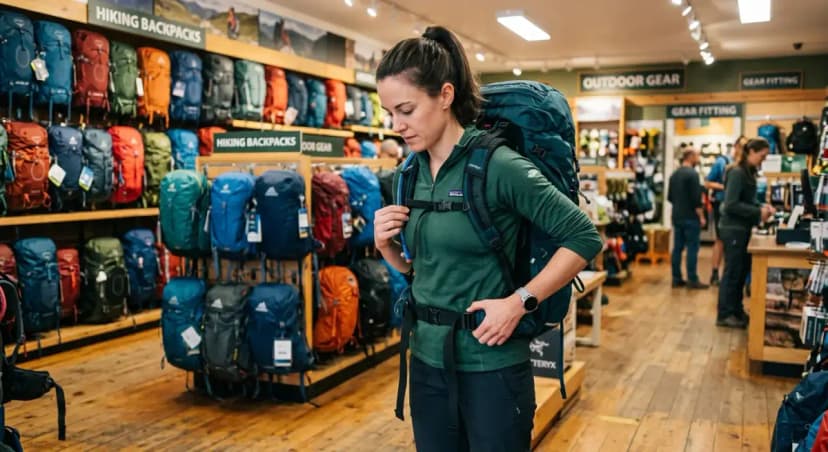
Never buy a backpack online without trying the specific model on first, unless you're replacing a pack you already know fits. When trying packs in a store:
- Tell the salesperson your torso measurement and let them select the right size range.
- Ask them to load the pack with weight, 20–30 lbs of sandbags is ideal. An empty pack fits differently than a loaded one.
- Loosen all straps, put the pack on, and tighten the hip belt first until it sits on your iliac crest.
- Tighten the shoulder straps until they contour your shoulders but aren't pulling away from the pack at the top.
- Pull the load lifters (the straps that angle from shoulder straps to the top of the pack) until they're at roughly 45 degrees.
- Tighten the sternum strap across your chest, this stabilizes the shoulder straps but shouldn't compress your chest.
- Walk around the store, squat, lean forward. There should be no hotspots, no pressure on your neck, and the hip belt shouldn't ride up when you move.
When to Buy Used vs. New
Backpacks age in ways that aren't visible from the outside. The midsole cushioning in the hip belt compresses over time; foam that looks fine may have lost meaningful support. If you're buying used, press the hip belt foam, it should spring back immediately. Slow recovery means compressed foam that won't carry load properly.
Buying a used pack from a reputable brand at a significant discount (>50% off) can be smart if the hip belt and frame are in good shape. Avoid used packs from brands without good resale infrastructure, replacement hip belts and stays are often unavailable for off-brand packs.
How to Choose a Hiking Backpack FAQs
Match volume to trip length: 15–25L for day hikes, 25–40L for 1–3 night trips, 40–55L for 3–7 night trips, 55–75L for week-plus expeditions. Most hikers overestimate how much volume they need. If you're between sizes, pick the smaller one and practice packing lighter.
Find your C7 vertebra, the prominent bone at the base of your neck when you tilt your head forward. Find your iliac crest, the top shelf of your hip bones on both sides. Measure the distance between these two points with a flexible tape measure. This is your torso length, which determines your pack size, not your overall height.
For a daypack: $65–$100 is the right range for quality without overpaying. For a weekend/backpacking pack: $180–$300 gets you a genuine suspension system and durable materials. Below those thresholds, you're compromising on load transfer or durability in ways that become apparent on real trips. Don't buy the cheapest pack and plan to replace it in a season.
Osprey is the most consistently reliable brand across price points and their All Mighty Guarantee (lifetime, covers any damage) is the best in the industry. Gregory makes better load transfer for very heavy packs. Deuter's women's-specific fit and back ventilation are category-leading. For ultralight, Hyperlite Mountain Gear. For budget, REI Co-op. Osprey wins on balance for most hikers.
Not optimally. A 45L backpacking pack is cumbersome on a day hike, too much volume encourages overpacking and the suspension is over-engineered for a light load. A 20L daypack can't fit overnight gear for most hikers. The better approach: own a dedicated daypack and rent or borrow a backpacking pack until you're doing overnight trips frequently enough to justify buying one.