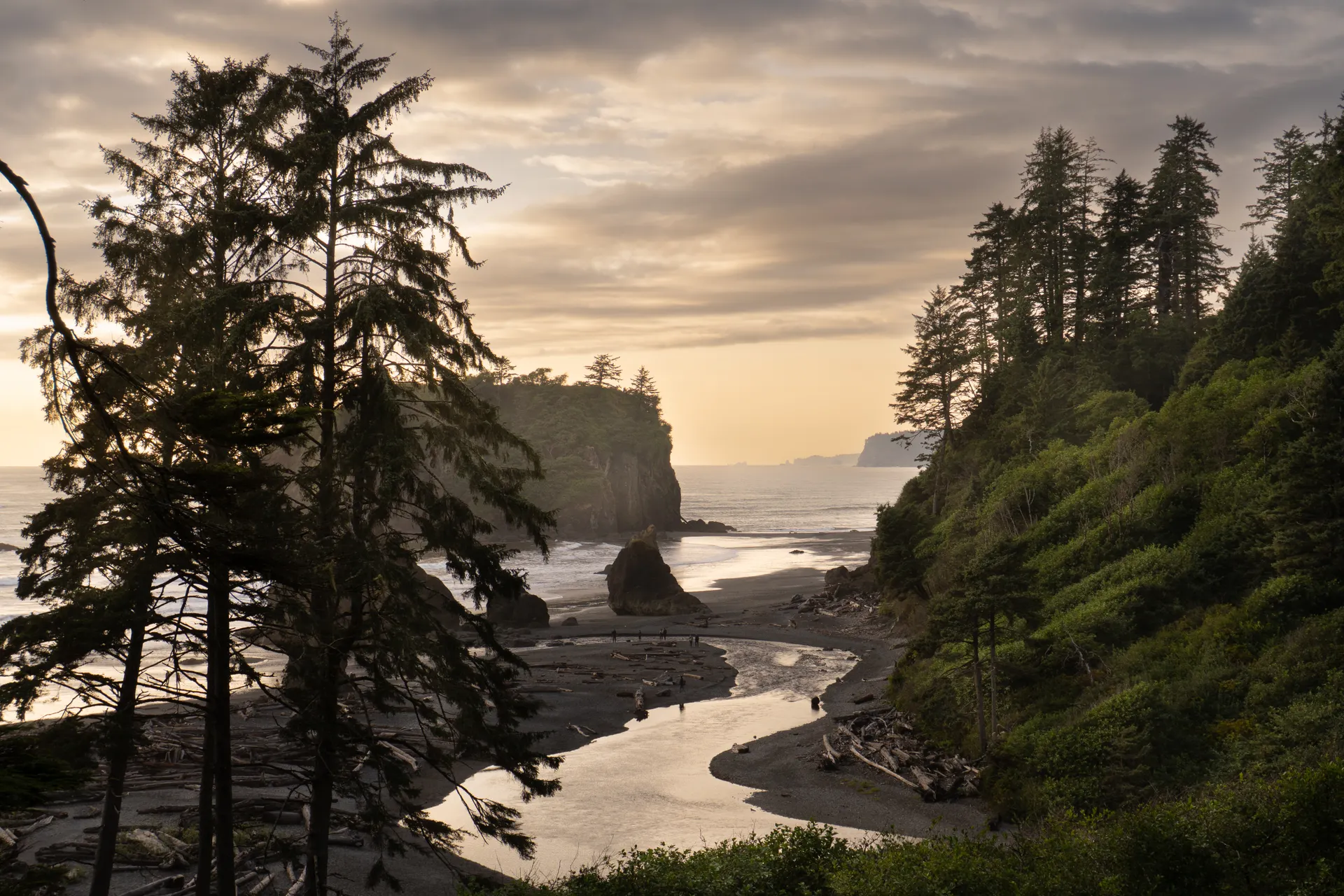
The Pacific coast of the Olympic Peninsula is some of the wildest shoreline in the lower 48. Instead of resort sand, you get fog-wrapped sea stacks, driftwood logs the size of telephone poles, and tide pools full of starfish and anemones. The beaches sit along a 60-mile stretch of Highway 101 and the spur roads near Forks and Kalaloch, and most are short walks from the parking lot. This guide covers the best stops on the Olympic National Park beaches, plus how to time the tides, where to stay, and how to string them into a single trip.
Ruby Beach
Ruby Beach is the postcard beach of the peninsula, named for the pinkish garnet sand that sometimes shows near the surf. A short, steep trail drops from the parking lot off Highway 101 to a beach studded with sea stacks and a famous freestanding arch. It faces west, so it is a top sunset spot. Come at low tide to explore the tide pools tucked around the rocks at the south end.
Rialto Beach
Rialto Beach, reached via Mora Road west of Forks, is a long crescent of smooth cobbles backed by a wall of bleached driftwood. Its signature hike is the 1.5-mile walk north to Hole-in-the-Wall, a sea arch you can walk through at low tide. Check a tide table before you go, because the route is impassable and dangerous at high tide. The tide pools here rank among the richest on the coast.
Second Beach and Third Beach
Near the Quileute village of La Push, a short forest trail leads to Second Beach, a wide strand framed by towering sea stacks and an offshore arch. The Second Beach trail is about 0.7 miles each way through coastal forest with a few sets of stairs, and it is a favorite for sunset and backcountry camping. Nearby Third Beach is a similar 1.4-mile round-trip walk and even quieter, with a waterfall spilling onto the sand at its south end.
Kalaloch and Beach 4
The Kalaloch area offers easier access and the famous Tree of Life, a Sitka spruce clinging to an eroded bluff with its roots fully exposed over a cave. The numbered beaches here, especially Beach 4, have excellent low-tide tide pools and gentler walks, making them good for families.
How to read the tides
Timing is everything on this coast. Many of the best features only appear at low tide, and a few routes turn deadly at high tide. Plan around the daily cycle before you leave cell service.
- Aim for a tide of 0.0 feet or lower for the fullest tide pools at Beach 4, Ruby, and Rialto
- Round headlands only on a falling tide, never a rising one, so you are not trapped against a cliff
- Give yourself a two-hour window on either side of low tide for the Hole-in-the-Wall walk at Rialto
- Download a tide chart for La Push or Kalaloch ahead of time, since signal is patchy west of Forks
Best time of year to visit
Summer, roughly July through early September, brings the driest, warmest weather and the lowest daytime tides, which is ideal for tide-pooling. Expect fog most mornings that usually burns off by midday. Spring and fall mean fewer crowds and dramatic storm light, but bring full rain gear. Winter draws storm-watchers to Kalaloch and Ruby Beach for towering surf, though many spur roads stay muddy and trails get slick. Wildflowers and the calmest seas tend to land in late June.
Where to stay near the coast
There is no single resort town, so most visitors base out of Forks or the historic Kalaloch Lodge right on the bluff above the beach. La Push has cabins run by the Quileute Oceanside Resort, and the small towns of Port Angeles and Sequim are an hour-plus east if you want more dining. Backcountry permits from the park let you camp on Second, Third, and Rialto beaches, but you must carry a bear canister and pitch your tent above the high-tide line.
What to pack
The coast stays cool and damp even in August, so dress for it and protect your gear from salt and sand.
- Waterproof shoes with grip for slick cobbles, driftwood, and tide-pool rocks
- Layers and a rain shell, since fog and wind keep the air chilly year round
- A headlamp if you plan to stay for sunset and walk back through the forest
- Drinking water and snacks, because there are no services at most trailheads
Tips for visiting the coast
- Check the tide chart before any walk that rounds a headland, especially Rialto and Hole-in-the-Wall
- Go at low tide for tide pools and at sunset for sea-stack photos
- Bring layers, since fog and wind keep the coast cool even in summer
- Never climb on slippery rocks near the surf, and watch for rogue waves and rolling logs
String the beaches together
The coast is the dramatic finale of a peninsula road trip. Our Olympic Peninsula Loop itinerary times the drive so you reach Ruby Beach or Kalaloch for sunset after a morning in the Hoh Rain Forest, then loops back toward Seattle. Plan to spend a full afternoon hopping between Ruby, Rialto, and Second Beach if your schedule allows.
Olympic Peninsula Beaches FAQs
Ruby Beach is the most iconic for sea stacks and sunsets and has the easiest access. Rialto Beach is best for the Hole-in-the-Wall hike and tide pools, while Second Beach near La Push is the most scenic forest-to-shore walk.
Yes. The walk north to Hole-in-the-Wall and the tide pools is only safe at low tide. At high tide the headland is impassable and dangerous, so always consult a local tide table before setting out.
Very. At low tide you can find sea stars, anemones, and crabs at Rialto Beach, Beach 4 near Kalaloch, and the rocky south end of Ruby Beach. Go during a minus tide for the best viewing and avoid stepping on the animals.