The best entrance to Yellowstone National Park depends on your goal. For geysers and first-timers, use the West Entrance at West Yellowstone, MT, it's closest to Old Faithful. For Lamar Valley wildlife, take the North or Northeast entrance. Pairing with Grand Teton? Use the South Entrance. The North Entrance is the only gate open to cars all winter.
Which Yellowstone entrance is best for first-time visitors?
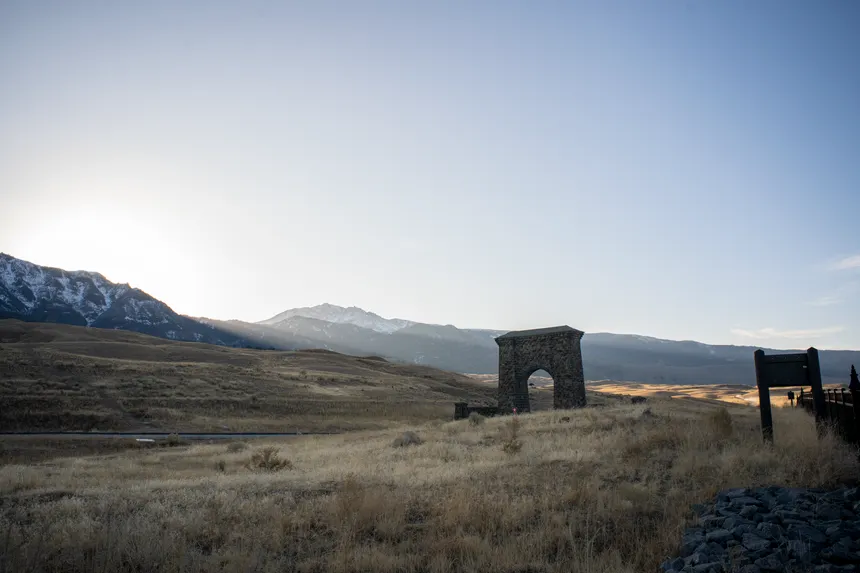
If you're flying in and want the headliners, Old Faithful, Grand Prismatic Spring, the Upper and Lower geyser basins, the West Entrance wins. It drops you onto the western side of the figure-eight Grand Loop Road, near the densest concentration of geysers and hot springs. Old Faithful is about 30 miles in (roughly 45–60 minutes). West Yellowstone is also the most built-up gateway town, with the most lodging, gas, and restaurants of any entrance.
The trade-off is crowds. The West Entrance is the busiest gate in summer, and the line of cars on a July morning can run 20–40 minutes or more. Be at the booth before 8 a.m. or push your arrival to late afternoon.
The five entrances at a glance
- West Entrance (West Yellowstone, MT)US-20/US-191. Best for geysers and first-timers. Nearest airport: Bozeman (BZN), ~90 miles / ~1 hr 45 min; seasonal West Yellowstone Airport (WYS) is in town.
- North Entrance (Gardiner, MT)US-89. Best for early/late season and the only gate open to cars year-round. Nearest airport: Bozeman (BZN), ~75–80 miles / ~1 hr 45 min.
- Northeast Entrance (Cooke City/Silver Gate, MT)US-212, the Beartooth Highway. Best for Lamar Valley wildlife and the most scenic drive in. Remote; Billings (BIL) is the practical fly-in, roughly 3.5 hours via the Beartooth in summer.
- South Entrance (from Grand Teton, WY)US-89/191/287. Best for combining Yellowstone with Grand Teton. Nearest airport: Jackson Hole (JAC), ~55 miles north through Teton.
- East Entrance (Cody, WY)US-14/16/20 over Sylvan Pass. Best for an eastern approach and the Cody Western vibe. Nearest airport: Cody/Yellowstone Regional (COD), ~52 miles / ~1 hr to the gate, then more to reach Yellowstone Lake.
Which entrance is best for wildlife?
For wolves, bison, grizzlies, and pronghorn, you want the northern tier of the park, the North or Northeast entrance. The Lamar Valleyoften called America's Serengeti, sits between Mammoth Hot Springs and the Northeast Entrance along the Northeast Entrance Road. It's one of the best places in the lower 48 to see wolves from the road, especially at dawn and dusk.
If wildlife is your priority, base in Gardiner (North) or Cooke City (Northeast). Enter the North Entrance and you can be parked at a Lamar pullout with a spotting scope by sunrise. The Northeast Entrance drive over the Beartooth Highway (US-212) is spectacular, it climbs to nearly 11,000 feet, but it's a long, slow approach and closed much of the year (typically mid-October to late May).
Which entrance is best for combining with Grand Teton?
The South Entrancehands down. Grand Teton National Park sits directly south of Yellowstone, connected by the John D. Rockefeller Jr. Memorial Parkway, so you can drive straight from the Tetons through the South Entrance without leaving protected land. Fly into Jackson Hole (JAC), spend a couple of days in Teton, then continue north. From Jackson to the South Entrance is roughly 55 miles; from the entrance to Old Faithful is about 40 miles more.
Which airport should I fly into for Yellowstone?
For the most flights and rental cars, fly into Bozeman Yellowstone International (BZN) in Montana, the best launch point for both the North Entrance (~75–80 miles) and the West Entrance (~90 miles). For the Grand Teton combo, fly into Jackson Hole (JAC). Coming from the east, Cody/Yellowstone Regional (COD) is about an hour from the East Entrance but has limited flights. Seasonal service runs to West Yellowstone (WYS), and Billings (BIL) is the larger hub for the Beartooth approach.
What are Yellowstone's fees?
A standard private-vehicle pass is $35good for 7 days at all entrances, so which gate you enter doesn't change the price. Motorcycles are $30, and a per-person (foot or bike) pass is $20. If you're also visiting Grand Teton, the $80 America the Beautiful annual pass covers both parks and every national park for a year and pays for itself fast on a two-park trip. (A $70 Yellowstone-only annual pass also exists for U.S. residents.) Bring a credit card; several entrance stations are cashless. Note: starting in 2026, non-U.S. residents pay an added surcharge unless they hold an annual pass.
Which entrances are closed in winter?
This is the detail that trips people up. From roughly early November through late Aprilmost park roads close to regular cars. The key exception:
- Only the North Entrance (Gardiner) stays open to wheeled vehicles all winteralong the road through Mammoth Hot Springs and east through Lamar Valley to the Northeast Entrance at Cooke City/Silver Gate.
- Because the road east of Cooke City closes for the season, in winter you must drive back out the way you camethere's no through-route until it's plowed in late spring.
- The West, South, and East entrances close to regular cars in early November. Interior winter travel (roughly mid-December to mid-March) is by guided snowmobile or snowcoach only.
- Most roads reopen to cars in stages through late April and May; some high passes (like Dunraven and the Beartooth) open later, into late May or June depending on snow.
So if you want to drive your own car in January to watch wolves on fresh snow in Lamar Valley, the North Entrance is your only option.
My honest recommendation
Pick your entrance around what you came to seenot just what's closest to your flight. Geysers and an easy first trip, West. Wolves and bison, North into Lamar. A two-park Teton adventure, South. The less-crowded, Western-Americana angle, East from Cody. The most spectacular drive, conditions permitting, Northeast over the Beartooth.
Whatever gate you choose, start early. Yellowstone is huge, the Grand Loop alone is about 140 miles, and the difference between a quiet 7 a.m. bison crossing and a midday traffic jam is just a few hours of sleep.
Best Entrance to Yellowstone National Park: All 5 Gates FAQs
It depends on your goal. The West Entrance (West Yellowstone, MT) is best for geysers and first-timers. The North and Northeast entrances are best for wildlife in Lamar Valley. The South Entrance is best for combining with Grand Teton. The North Entrance is the only one open to cars in winter.
The West Entrance at West Yellowstone, Montana is closest, about 30 miles, or roughly 45–60 minutes, to Old Faithful and the major geyser basins. It's the most popular gate for first-time visitors but also the busiest in summer.
Only the North Entrance at Gardiner, MT stays open to regular cars in winter, along the road through Mammoth Hot Springs and east to Cooke City via Lamar Valley. The West, South, and East entrances close to cars in early November; interior travel is by snowmobile or snowcoach only until spring.
Enter via the North Entrance (Gardiner) or Northeast Entrance (Cooke City). Both put you near Lamar Valley, one of the best places in the lower 48 to spot wolves, bison, and grizzlies, especially at dawn and dusk. The North Entrance is the more practical year-round choice.
Bozeman Yellowstone International (BZN) has the most flights and rental cars and serves both the North (~75–80 miles) and West (~90 miles) entrances. Fly into Jackson Hole (JAC) for the Grand Teton combo, or Cody (COD) for the East Entrance.
A private-vehicle pass is $35 and is valid 7 days at all entrances, so the gate you choose doesn't change the price. Motorcycles are $30 and individuals on foot or bike are $20. An $80 America the Beautiful annual pass covers Yellowstone, Grand Teton, and all national parks for a year.