Why Post-Hike Stretching Matters
Your muscles contract thousands of times on a hike. Without stretching, they stay shortened, meaning your hamstrings, hip flexors, and calves tighten up overnight, and you wake up walking like you're 30 years older than you are. A 15-minute stretch routine done consistently after every hike makes a measurable difference in how you feel the next morning and how quickly you're ready to go again.
This routine targets every muscle group that takes a real beating on the trail: quads (especially on descents), hip flexors (from sustained uphill), calves and Achilles (from all-day walking), hamstrings, glutes, and the lower back.
The 15-Minute Post-Hike Stretching Routine
1. Standing Quad Stretch (60 seconds each leg)
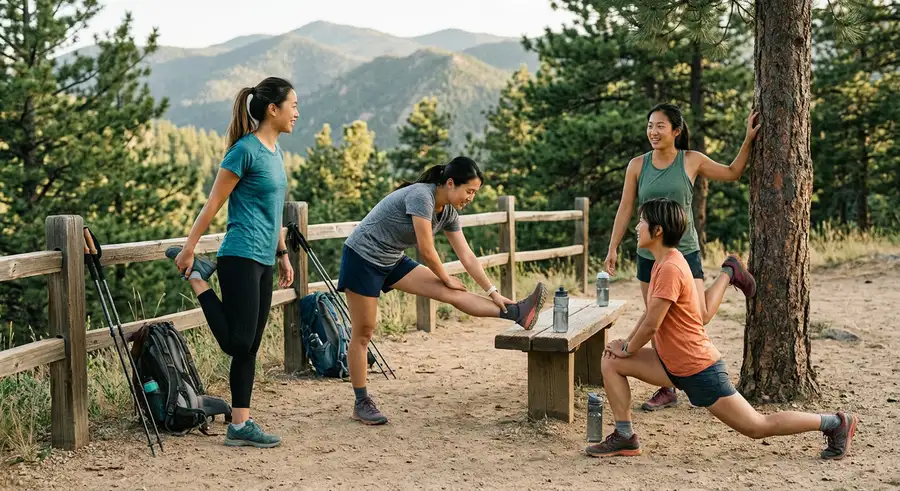
Stand near a wall or tree for balance. Bend one knee and hold your ankle behind you, pulling your heel toward your glute. Keep your knees together and stand tall, don't lean forward. You should feel a deep pull along the front of your thigh. This is the single most important stretch for hikers who do significant descents.
Common mistake: Pulling the ankle to the side instead of directly behind you. This strains the knee rather than stretching the quad.
2. Hip Flexor Lunge Stretch (60 seconds each side)
Step one foot forward into a lunge, dropping your back knee to the ground. Shift your weight forward until you feel a stretch at the front of your back hip, not your front quad. Tuck your pelvis slightly under (posterior tilt) to deepen the stretch. Sustained uphill hiking keeps your hip flexors in constant contraction; this is the fix.
Progression: Once comfortable, raise the same-side arm overhead and lean slightly away from the stretched side for a combined hip flexor and lateral torso stretch.
3. Downward Dog Calf and Hamstring Stretch (90 seconds)
From hands and knees, push your hips up and back into an inverted V. Press your heels toward the ground, they don't need to touch. Pedal each foot slowly, bending one knee while pressing the other heel down. This addresses both the calf and the hamstring in one position and also decompresses the lower back after a long day under pack weight.
4. Seated Hamstring Stretch (60 seconds each leg)
Sit on the ground with one leg extended, the other foot tucked against your inner thigh. Hinge at the hips (not the lower back) and reach toward your extended foot. If you can't reach without rounding your back severely, loop a bandana or trekking pole strap around your foot and hold both ends. Keep the stretch in the back of your thigh, not your lower back.
5. Figure-Four Glute Stretch (60 seconds each side)
Lie on your back. Cross one ankle over the opposite knee, forming a figure-4 shape. Pull both legs toward your chest. This targets the piriformis and deep glutes, muscles that fatigue on long climbs and can trigger sciatic-type pain if ignored. This stretch consistently gets votes as the most satisfying post-hike stretch from long-distance hikers.
6. IT Band / Lateral Hip Stretch (45 seconds each side)
Stand and cross your right foot behind your left. Lean your upper body to the left, pushing your right hip outward. You'll feel a stretch along the outside of your right hip and thigh, the IT band. This is especially important after trails with lots of lateral terrain variation or for hikers who experience knee pain on descents.
7. Standing Calf / Achilles Stretch (60 seconds each leg)
Step one foot back about 2 feet from a wall or tree. Keep your back heel flat on the ground and lean forward until you feel a stretch in the calf. For the Achilles specifically, bend your back knee slightly while keeping the heel down, this shifts the stretch lower. After 10+ miles, your Achilles takes a pounding; this is non-negotiable on longer days.
8. Chest Opener / Thoracic Stretch (45 seconds)
Clasp your hands behind your back and gently squeeze your shoulder blades together while opening your chest upward. Hours of hunching forward under a pack tightens the pecs and anterior shoulders. This stretch is quick and feels immediately good. Follow it with 5–10 slow neck rolls.
9. Supine Spinal Twist (60 seconds each side)
Lie on your back, pull one knee to your chest, then drop it across your body while extending that arm out to the side. Look away from the knee. This decompresses lumbar vertebrae that have been under axial load all day. If you only do one stretch at camp, make it this one.
Timing and Frequency
Do this full routine within 20 minutes of finishing your hike. If you're backpacking, stretch before setting up camp, not after, you'll skip it if you wait. On multi-day trips, doing even half this routine nightly makes the second and third days dramatically more comfortable.
What to Do If You're Too Sore to Stretch
If you're so sore that stretching hurts, focus only on gentle range-of-motion movements rather than held stretches. Ice large muscle groups for 10–15 minutes, then do light static stretching. Anti-inflammatory medications like ibuprofen (400–600mg) can help if soreness is severe, though they shouldn't become routine after every hike. The best long-term solution is progressive training so your muscles adapt to the load you're asking of them.
Foam Rolling After Hiking
A foam roller adds significant benefit if you carry one to camp or have one at home. Prioritize: IT band (outside of thigh), quads, and calves. Spend 60–90 seconds per area, pausing on tender spots. The TriggerPoint GRID roller (around $35) is the most durable option that serious hikers actually keep using. Cheaper rollers compress immediately and lose effectiveness.
How to Stretch After Hiking FAQs
Stretch within 10–20 minutes of finishing your hike while your muscles are still warm. Cold muscles are less pliable and stretching them can cause small tears. If you've cooled down completely, do a 5-minute brisk walk first.
Hold each stretch for 30–60 seconds. Research supports that 30 seconds produces most of the flexibility benefit. Going beyond 60 seconds per stretch adds diminishing returns for most hikers.
After, primarily. Before a hike, do dynamic warm-up movements (leg swings, hip circles, walking lunges) not static stretches. Static stretching before exercise can temporarily reduce muscle power output. Save the held stretches for post-hike.
Descending puts your quads under eccentric load, they're contracting while lengthening to control your descent, which causes more micro-tears than concentric work. This is called DOMS (delayed onset muscle soreness). The quad stretch and step stretch below directly address this.
Stretching doesn't prevent blisters (that's a friction/moisture issue) but it does reduce knee pain risk. Tight IT bands and hip flexors change your gait mechanics, which loads the knee joint unevenly. Regular stretching of the hip flexors, quads, and IT band reduces that risk significantly.