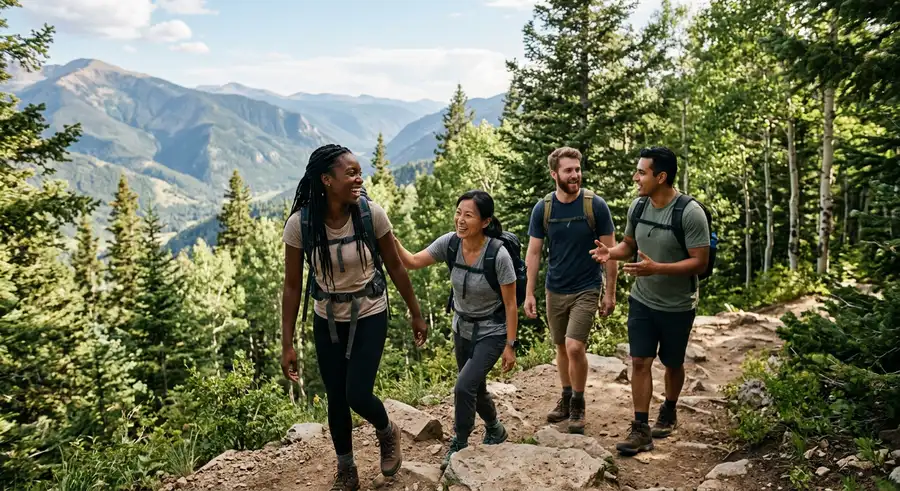
Why Hiking Is Different From Other Exercise

Most forms of cardio happen in controlled environments, a treadmill, a pool, a track. Hiking happens in unpredictable terrain, changing weather, and natural surroundings that actively engage your brain while your body works. That combination produces benefits that indoor exercise simply can't replicate, and the research over the last two decades has gotten specific enough to explain why.
This isn't about hiking being better than running or cycling. It's about understanding what happens physiologically and psychologically when you walk on uneven ground through natural environments for two or more hours, and why that specific activity has effects on the human body that are measurably different from equivalent-intensity gym workouts.
What Happens to Your Cardiovascular System
A moderate 5-mile hike with 1,000 feet of elevation gain burns between 400 and 700 calories depending on your body weight and pack weight, roughly equivalent to a 45-minute run at a conversational pace. But the cardiovascular demand is different from running in one important way: hiking is sustained, low-to-moderate intensity work over a longer duration, which trains your aerobic base more efficiently than shorter, higher-intensity efforts.
Your heart rate during a hike typically sits between 50% and 75% of max, the zone where your body adapts by building more mitochondria in muscle cells, increasing stroke volume (how much blood your heart pumps per beat), and improving the efficiency of oxygen delivery to working muscles. Over months of regular hiking, your resting heart rate drops and your VO2 max, the best single measure of cardiovascular fitness, increases.
Uphill sections push you into higher heart rate zones temporarily, which adds interval-training-like bursts to your base aerobic work. The net result is cardiovascular conditioning that works across multiple training zones in a single outing, which is why many cardiologists specifically recommend hiking over flat-surface walking for patients recovering from cardiac events.
What Hiking Does to Your Muscles and Joints
Hiking engages muscle groups that most people barely use in daily life. The glutes, hamstrings, hip flexors, and stabilizing muscles around the ankle and knee are all recruited constantly on uneven terrain, not just during the uphill sections but throughout the entire hike as your body makes hundreds of micro-adjustments to maintain balance.
Descents are particularly demanding. Going downhill puts 3–4 times your body weight on your knee joint with each step, and your quadriceps work eccentrically, contracting while lengthening, to control the descent. This eccentric loading is exactly what builds functional quad strength, which is why experienced hikers tend to have strong knees rather than damaged ones. The damage typically happens to people who attempt difficult descents before their muscles are strong enough to handle the load.
The impact profile of hiking is also meaningfully different from running. Trail surfaces absorb more shock than pavement, and the variable terrain means no single joint or muscle bears repetitive identical loading. This makes hiking genuinely lower-impact than road running while still providing substantial musculoskeletal conditioning, which is why it's often prescribed for people with joint issues who can't tolerate running.
Bone density is another underappreciated benefit. Hiking is weight-bearing exercise, which means it stimulates bone remodeling. Women over 40 who hike regularly show measurably higher bone density than sedentary peers, which directly reduces osteoporosis risk. Even carrying a light pack (10–20 lbs) amplifies this effect.
The Specific Mental Health Effects
The mental health benefits of hiking are where the research gets genuinely surprising. A 2015 Stanford study compared brain activity in people who walked for 90 minutes in either a natural environment (a quiet, tree-lined path) or an urban environment (a busy street). The nature walkers showed significantly reduced activity in the subgenual prefrontal cortex, the brain region associated with rumination, the repetitive negative self-focused thinking linked to depression and anxiety.
This wasn't a small effect. The nature walkers reported lower levels of rumination after the walk, and their brain scans confirmed the reduction was neurological, not just self-reported. Urban walkers showed no such change despite identical exertion.
Cortisol, the primary stress hormone, drops measurably after time in natural environments. Studies on forest bathing (shinrin-yoku) in Japan have documented cortisol reductions of 12–15% after just 20 minutes in a forested environment, with effects that persist for hours afterward. Hiking in forests or open alpine terrain combines this environmental effect with the endorphin release of sustained physical exercise, producing a compound reduction in stress hormones that outlasts the hike itself.
Attention restoration theory, developed by psychologists Rachel and Stephen Kaplan, proposes that natural environments provide a type of passive, effortless attention (watching water move, noticing birds, navigating terrain) that allows the directed attention networks used for focused work to recover. Hiking is essentially a forced rest for the part of your brain that handles concentration, which is why many people report feeling mentally sharper for days after a substantial hike.
Sleep Quality
Regular hikers consistently report better sleep, and the mechanism is well understood. Physical exertion increases slow-wave sleep, the deep, restorative phase where tissue repair, immune function, and memory consolidation happen. But hiking adds a second sleep-improving factor: sunlight exposure.
Being outside in natural light during the day, especially in the morning, reinforces your circadian rhythm by signaling to your brain that daytime is daytime. This makes the melatonin release that triggers sleep onset happen more reliably at night. People who hike in morning light and are physically tired from the exertion fall asleep faster, sleep more deeply, and wake up more refreshed than equivalent exercisers who train indoors.
If you have trouble sleeping, a Saturday morning hike is one of the most effective interventions you can make, more effective than most supplements and comparable to low-dose melatonin for improving sleep architecture that same night.
Social and Psychological Benefits
Hiking with other people produces social bonding effects that are qualitatively different from socializing in most other contexts. Shared physical challenge, reduced phone use, extended time away from built environments, and the absence of the social performance pressure that comes with urban socializing all contribute to deeper conversation and stronger connection than you'd typically achieve over dinner or drinks.
Research on awe, the emotion triggered by encounters with things that are vast, complex, or beyond your normal frame of reference, shows that experiences of awe reliably increase prosocial behavior, reduce self-focused thinking, and increase feelings of connectedness and meaning. Mountains, canyons, open ridgelines, and old-growth forests reliably trigger awe in ways that urban environments rarely do. Regular hikers aren't just healthier, studies show they consistently score higher on measures of life satisfaction and sense of purpose than comparable non-hikers.
Solo hiking has its own psychological benefits. The combination of solitude, physical challenge, and natural environment forces a kind of mental clarity that's hard to achieve in daily life. Many hikers describe solo days on trail as meditative, not because they're trying to meditate, but because the demands of navigation, physical effort, and environmental awareness naturally quiet the background mental noise of ordinary life.
How Much Hiking Do You Need to See Benefits?
The evidence suggests meaningful benefits start at one substantial hike per week (2+ hours, moderate terrain). Two hikes per week produces significantly better outcomes across most health measures. Daily short walks in natural environments add incremental benefit on top of weekend hiking, but they don't fully substitute for longer efforts.
For cardiovascular fitness, the minimum effective dose is roughly 150 minutes of moderate hiking per week, the same as the general exercise guidelines. But because hiking is more enjoyable for most people than treadmill walking, adherence is dramatically better. The best exercise is the one you actually do consistently, and people stick with hiking at much higher rates than equivalent-intensity gym programs.
You don't need to hike hard or cover big miles to get most of the benefits. A 5-mile hike with 1,000 feet of gain on varied terrain, done regularly, is enough to see measurable improvements in cardiovascular fitness, mental health, sleep quality, and bone density within 8–12 weeks.
Starting Out: Making the Benefits Actually Happen
The most common reason people don't experience hiking benefits is starting too hard. A 12-mile mountain hike as your first outing produces soreness, discouragement, and sometimes injury, the opposite of what you want. Start with trails under 5 miles and under 800 feet of gain. Let your body adapt. Increase distance and elevation gain by no more than 10–15% per week.
Footwear matters more than almost anything else in the first months. Road shoes on rocky terrain increase ankle roll risk dramatically. Trail runners or light hiking shoes with aggressive outsoles transform the experience, you spend energy hiking instead of managing footing, and your ankles and knees stay safe. You don't need heavy leather boots for day hiking. Light and grippy beats heavy and stiff for most trails.
Bring more water than you think you need (half a liter per hour of hiking is a solid baseline), eat something every 60–90 minutes even if you're not hungry, and start early. Most of the physical and mental benefits of hiking are amplified by morning light, cooler temperatures, and the quieter, less crowded trails that come with an early start.
The Real Benefits of Hiking FAQs
Research shows meaningful benefits start with one 2+ hour moderate hike per week. For cardiovascular fitness, aim for 150 minutes of moderate hiking per week total. You'll notice changes in energy, sleep, and mood within 2–4 weeks of consistent hiking.
Yes, but it works best as part of a sustainable routine rather than a crash approach. A 5-mile hike with 1,000 feet of gain burns 400–700 calories. The bigger benefit for weight management is that hiking builds muscle (especially in the legs and core) that raises your resting metabolic rate over time.
Yes, particularly in the quads, glutes, hamstrings, and calves. Descents build eccentric quad strength that few other exercises match. Carrying a pack adds upper body and core work. Hiking won't replace dedicated strength training, but regular hikers develop noticeably stronger lower bodies within a few months.
The evidence is strong. Multiple studies show hiking in natural environments reduces cortisol (stress hormone), decreases rumination (repetitive negative thinking linked to depression), and improves mood for days after a hike. The combination of physical exertion and natural surroundings produces effects that indoor exercise alone doesn't replicate.
Once a week is enough to see meaningful benefits over 8–12 weeks. Twice a week produces significantly better outcomes across cardiovascular fitness, mental health, and sleep quality. Daily short walks in natural environments add incremental benefit but don't fully replace longer trail efforts.