You Need to Filter Backcountry Water, No Exceptions
The "this stream looks pristine" reasoning has sent thousands of hikers home early with giardia. Giardia lamblia and Cryptosporidium live in virtually every backcountry water source in North America, put there by animals whose entire watershed you share. Clear water is not clean water. The incubation period for giardia is 1–3 weeks, meaning you'll get sick well after you've convinced yourself the water was fine.
Filtering or purifying water on trail adds less than five minutes to your routine. The consequences of not doing it can take six weeks to resolve with prescription medication. The math is obvious. Here's which filter to use.
Types of Water Treatment
There are four approaches to backcountry water treatment, each with a distinct profile:
- Hollow fiber filters (Sawyer, Platypus): Remove bacteria and protozoa (giardia, crypto) through physical filtration. Fast, reliable, work in near-freezing temperatures. Don't remove viruses, not usually a concern in the North American backcountry, significant concern internationally.
- Gravity filters (Platypus GravityWorks): A hollow fiber filter plumbed between two reservoirs. You fill the dirty bag, hang it, and gravity pushes water through into the clean bag while you do other camp chores. No pumping or squeezing. The fastest hands-off way to produce large volumes, which makes it the favorite for groups and base camps.
- Pump filters (MSR MiniWorks, Katadyn Hiker Pro): Older technology, heavier, but filters water quickly into any container. Good for groups and silty water.
- UV purifiers (SteriPen): Kill bacteria, protozoa, and viruses with UV light. Fast, no pumping, no taste change. Require batteries. Don't work well in silty water without pre-filtering.
- Chemical treatment (Aquatabs, iodine): Lightest possible option. Kills bacteria and viruses but takes 30–60 minutes to work. Not as effective against crypto. Best as backup, not primary.
Our Top Picks
Best Overall: Sawyer Squeeze
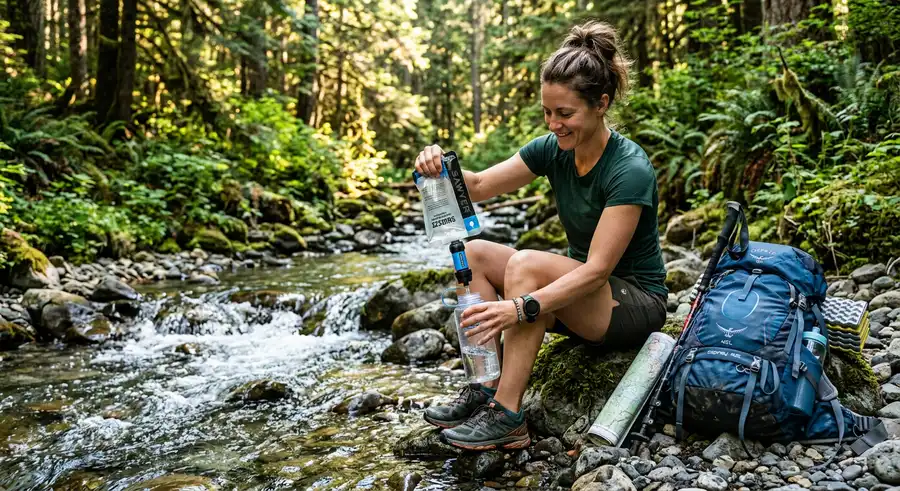
The Sawyer Squeeze ($35) is the best all-around filter for backpacking and has been for a decade. It weighs 3 oz, screws directly onto standard water bottles and hydration bladders, filters up to 100,000 gallons before needing replacement (essentially lifetime for most users), and removes 99.9999% of bacteria and 99.9999% of protozoa. You squeeze water through the filter directly into your mouth or a container, no pumping required, no batteries.
The filter can be backflushed to restore flow rate when it slows. The included syringe makes this easy in the field. It doesn't filter viruses (not a concern in US and Canada backcountry) and the squeeze pouches it comes with are fragile, upgrade to a CNOC Vecto or Platypus Platy bottle for a more durable setup. At this price and weight, there's no reason not to own one.
Best for International Travel: Katadyn BeFree
The Katadyn BeFree ($45) uses hollow fiber technology like the Sawyer but pairs it with a collapsible soft flask (the Hydrapak Seeker). You fill the flask, squeeze through the filter. The flow rate is exceptional, 2 liters per minute on a clean filter. For international hiking where viral contamination is a concern, pair it with chemical treatment or a SteriPen for complete protection.
The BeFree's filter is not backflushable in the field, you swish it in water to clean, which works reasonably well. Weight is 2.4 oz. The flask integrated design is particularly clean for day hiking.
Best for Speed: MSR TrailShot
The MSR TrailShot ($50) is a squeeze-type filter in a pistol-grip form factor. You hold the inlet in the water source and squeeze the body, no need to fill a separate container. It works well from puddles and shallow sources where filling a bottle is awkward. Flow rate is 1 liter per minute. Weight is 2.6 oz. For solo hikers doing fast-and-light day hikes with abundant water sources, the convenience is genuine. It's slightly heavier and more expensive than the Sawyer Squeeze for what is mostly a convenience difference.
Best Gravity Filter: Platypus GravityWorks 4L
The Platypus GravityWorks 4L ($120) is the best gravity water filter for groups and basecamps, and the most relaxing way to treat water on trail. You scoop 4 liters into the dirty reservoir, hang it from a branch, and the hollow fiber filter delivers clean water into the second bag in about two and a half minutes with zero effort while you set up the tent or cook. It removes bacteria and protozoa to 0.2 micron, backflushes by simply reversing the bags, and the filter cartridge is rated to 1,500 liters. At roughly 11.5 oz for the full kit it is heavier than a squeeze filter, so it shines for two or more people rather than solo ultralight trips. A 2L version trims weight for couples.
Best for Groups: MSR Guardian
The MSR Guardian ($350) is the pump filter that guides, military units, and search-and-rescue teams carry because it handles anything. It removes bacteria, protozoa, and viruses, works in silty water, can be operated with one hand, and is virtually indestructible. The price is high and the weight (17 oz) rules it out for solo ultralight use. For base camps, group trips, and international expeditions where you need guaranteed performance in challenging conditions, nothing else comes close.
Best UV Purifier: SteriPen Adventurer Opti
The SteriPen Adventurer Opti ($80) purifies a 1-liter bottle in 90 seconds using UV-C light, killing bacteria, protozoa, and viruses. It runs on 2 CR123 batteries (about 50 liters per set), weighs 3.6 oz with batteries, and leaves no taste or chemical residue. The ideal pairing is a Sawyer Squeeze (primary filter for particulates and pathogens) plus SteriPen (add-on for viral coverage before international travel). The SteriPen alone in silty water is less effective, UV doesn't penetrate turbid water well.
Best Backup: Aquatabs
Aquatabs water purification tablets ($9 for 50 tablets) deserve space in every kit as a backup. Each tablet treats 1 liter in 30 minutes, removes bacteria and viruses (less effective on crypto), and the entire supply weighs less than an ounce. When your primary filter freezes, breaks, or clogs mid-trip, Aquatabs get you through. They're not a replacement for a proper filter but as insurance they're unbeatable for the weight and cost.
Common Mistakes
- Letting your filter freeze: Ice in the filter membrane can crack it, making the filter unsafe without visible damage. In freezing temperatures, sleep with your filter or carry it in an insulated pouch.
- Skipping treatment on "clear" water: Clarity doesn't indicate safety. Glacial melt, spring water, and alpine lakes all carry pathogens.
- Not backflushing: A Sawyer Squeeze that hasn't been backflushed after a sandy creek can slow to a trickle. Backflush after every trip to maintain flow rate.
- Using a UV pen in silty water: The UV light can't penetrate turbid water effectively. Pre-filter through a bandana to remove particulates before UV treatment.