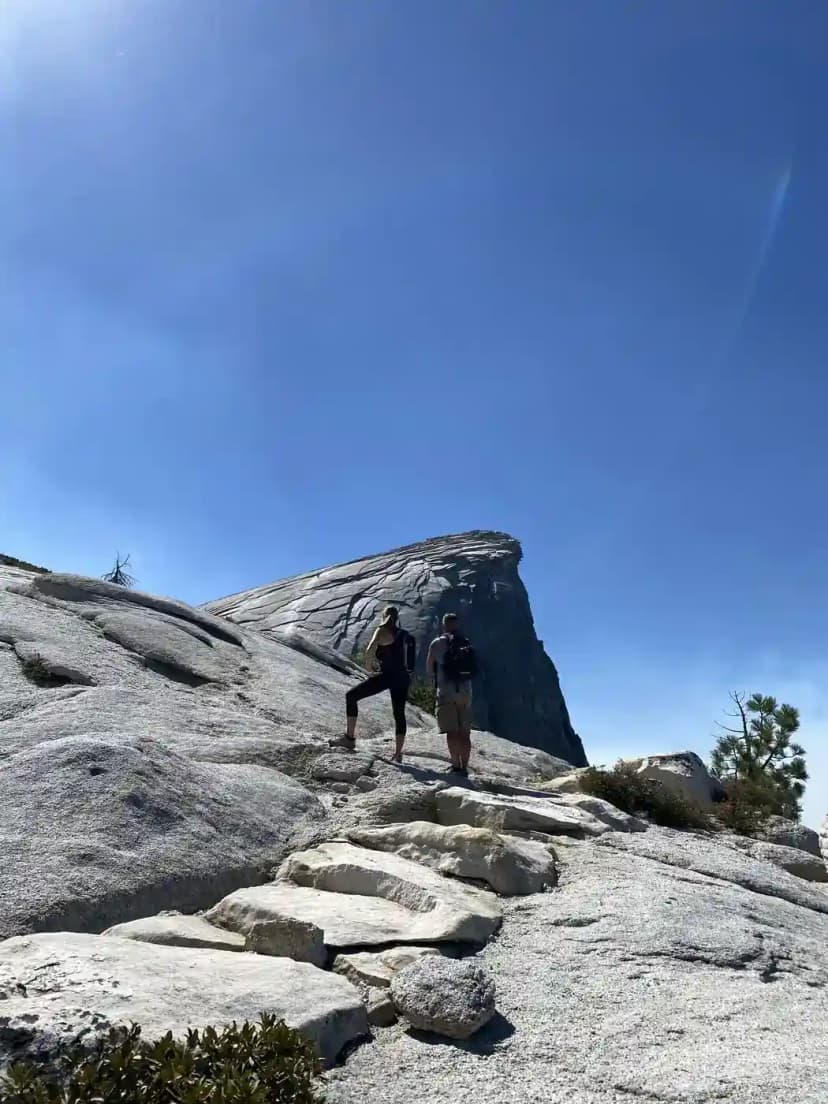
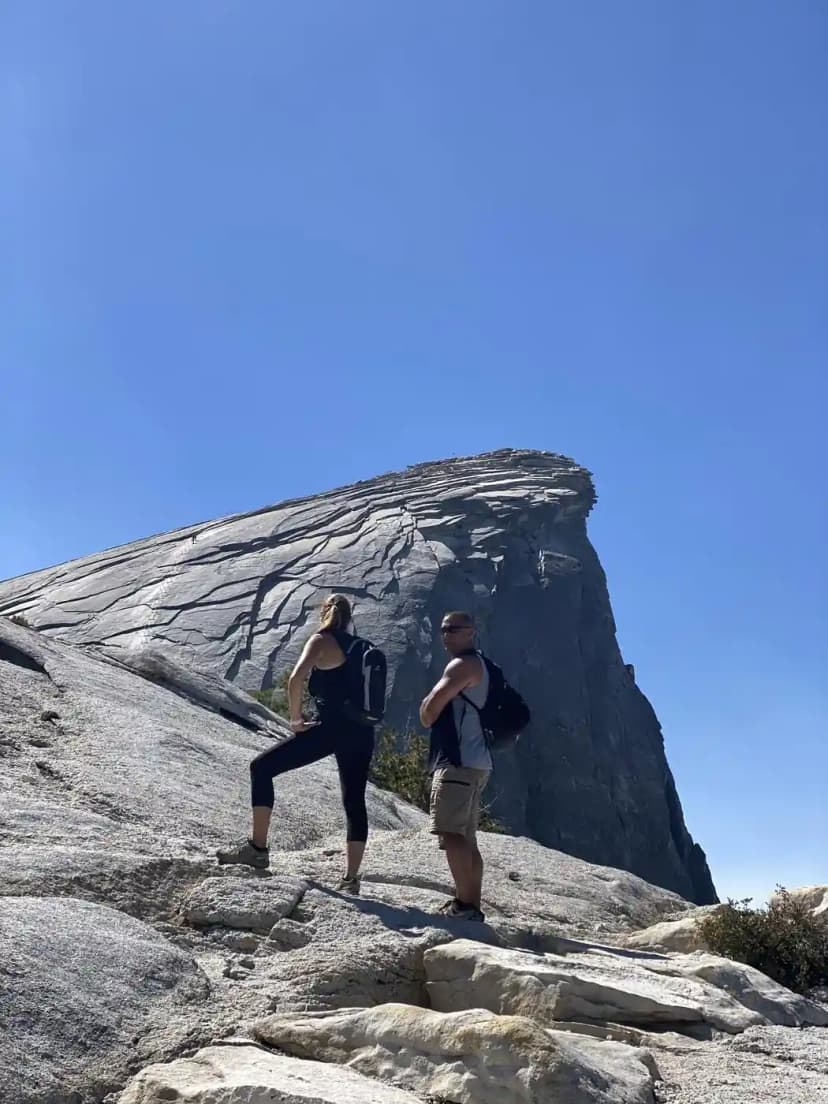
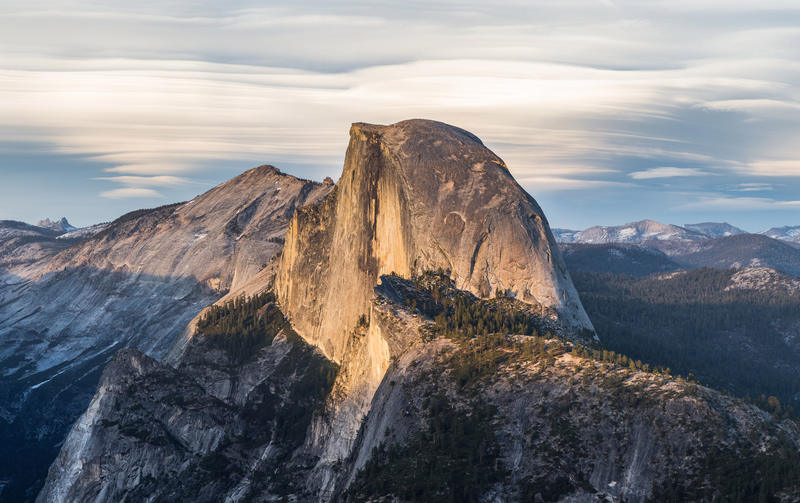
The Diving Board is a granite ledge on the southwest shoulder of Half Dome that juts out opposite the vertical northwest face. It is where Ansel Adams made Monolith, The Face of Half Dome in 1927, and it is one of the few places you can look straight across at the wall rather than down from the top.
Getting there means the Death Slabs, and that name is not decoration.
What the Death Slabs are
The Death Slabs are the climbers’ approach to the base of the northwest face, running up the steep broken ground below the wall from the valley floor near Mirror Lake. They are a mixture of slab, loose talus, brush and short cliff bands, threaded by fixed ropes that previous climbers have left behind.
Several things make them genuinely dangerous rather than merely unpleasant:
- The fixed ropes are of unknown age and unknown condition. Nobody maintains them. They are sun-bleached, abraded where they run over edges, and anchored to whatever was handy at the time.
- Rockfall. The ground is loose and there are usually people above you.
- Route finding is poor. There is no trail, the ground all looks similar, and people regularly end up on steeper terrain than they intended, especially coming down.
- It is worse in descent, in the dark, tired, which is when most parties do it.
This is not a hike. It is unroped scrambling on loose ground with objective hazard, and it is the approach climbers accept because it is the fastest way to the base of the wall, not because it is safe.
Should you go?
If you are asking whether the Death Slabs are a reasonable way to reach a viewpoint, the answer is no. They exist to get climbers to the bottom of a big wall. Going up them for a photograph, without the judgement that comes from a lot of time on loose alpine ground, is how people get hurt in a place that is hard to reach with a rescue.
Experienced scramblers who are honest with themselves about loose rock, who go in a small group, early, with helmets, and who treat every fixed rope as decorative rather than load-bearing, do this regularly and without incident. That is a narrow description and it is worth checking whether it is you.
The photograph
Adams carried a large-format camera up there in 1927 and used a deep red filter to darken the sky, and the resulting image is usually described as the moment he stopped recording what a scene looked like and started making it feel like something. That idea, previsualisation, ran through the rest of his career.
Part of the reason the picture still works is the position. From the Diving Board you are level with the face rather than above or below it, close enough that the wall fills the frame with nothing to give it scale.
Seeing the northwest face without the slabs
You do not have to go anywhere near them to see the thing itself.
| Where | Effort | What you get |
|---|---|---|
| Glacier Point | Drive, then a short walk | The classic profile across the valley |
| Olmsted Point | Roadside on Tioga Road | The back of the dome, and far fewer people |
| Clouds Rest | 14 mi hike, no permit | Higher than Half Dome, looking down on it |
| Washburn Point | Roadside | A steeper, less photographed angle than Glacier Point |
| Mirror Lake | Flat 2 mi walk | Directly beneath the face, looking up |
Mirror Lake is the underrated one. It is a flat walk from the valley floor, and standing at the bottom looking up nearly 5,000 feet of granite gives you a better sense of the scale of the wall than any view from across the valley does.
The Diving Board and the Death Slabs on Half Dome FAQs
A granite ledge on the southwest shoulder of Half Dome that sits opposite the vertical northwest face, so you look across at the wall rather than down from the summit. Ansel Adams photographed Monolith, The Face of Half Dome from there in 1927.
The climbers’ approach to the base of Half Dome’s northwest face, running up steep broken ground from near Mirror Lake. It is a mixture of slab, loose talus, brush and short cliff bands, threaded with fixed ropes left by previous parties. It is unroped scrambling with real objective hazard, not a hiking route.
Treat them as decorative rather than load-bearing. Nobody maintains them, they are of unknown age, sun-bleached and abraded where they run over edges, and anchored to whatever was convenient at the time. Parties who do this regularly do not trust their weight to them.
Not in any normal sense of hiking. Reaching it means the Death Slabs, which involve loose rock, rockfall from parties above, poor route finding and a descent that is worse than the ascent. If the goal is a viewpoint rather than the bottom of a big wall, it is the wrong way to get one.
Glacier Point for the classic profile, Olmsted Point for the back of the dome with fewer people, Washburn Point for a steeper angle, and Clouds Rest if you want to look down on it. Mirror Lake is the underrated one: a flat two mile walk that puts you directly beneath nearly 5,000 feet of granite.
Yes, the Half Dome Cables is required. Cables-route day-hike lottery for Half Dome.
Application window: the month of March (preseason lottery).
Moderate (~20–30% preseason)
Daily lottery 2 days before your hike, or stop at the sub-dome viewpoint (no permit needed).
Yosemite Valley, CA is the gateway town, flying into Fresno Yosemite (FAT).
Yes. The worked day-by-day plan is Yosemite Hiking Trips: Best Trails & Complete Guide (Multi-day), with the permits, the stays and the drive times already sorted. Tell us your dates and we will put it together for you and confirm what is genuinely open on those days. Asking is free: no card, no deposit, and nothing is held until you say yes.